
A Man With a 156 IQ Who Couldn’t Remember a Thing: The Bill Clinton Deposition
"Photo from the Epstein files, released by the Justice Department"

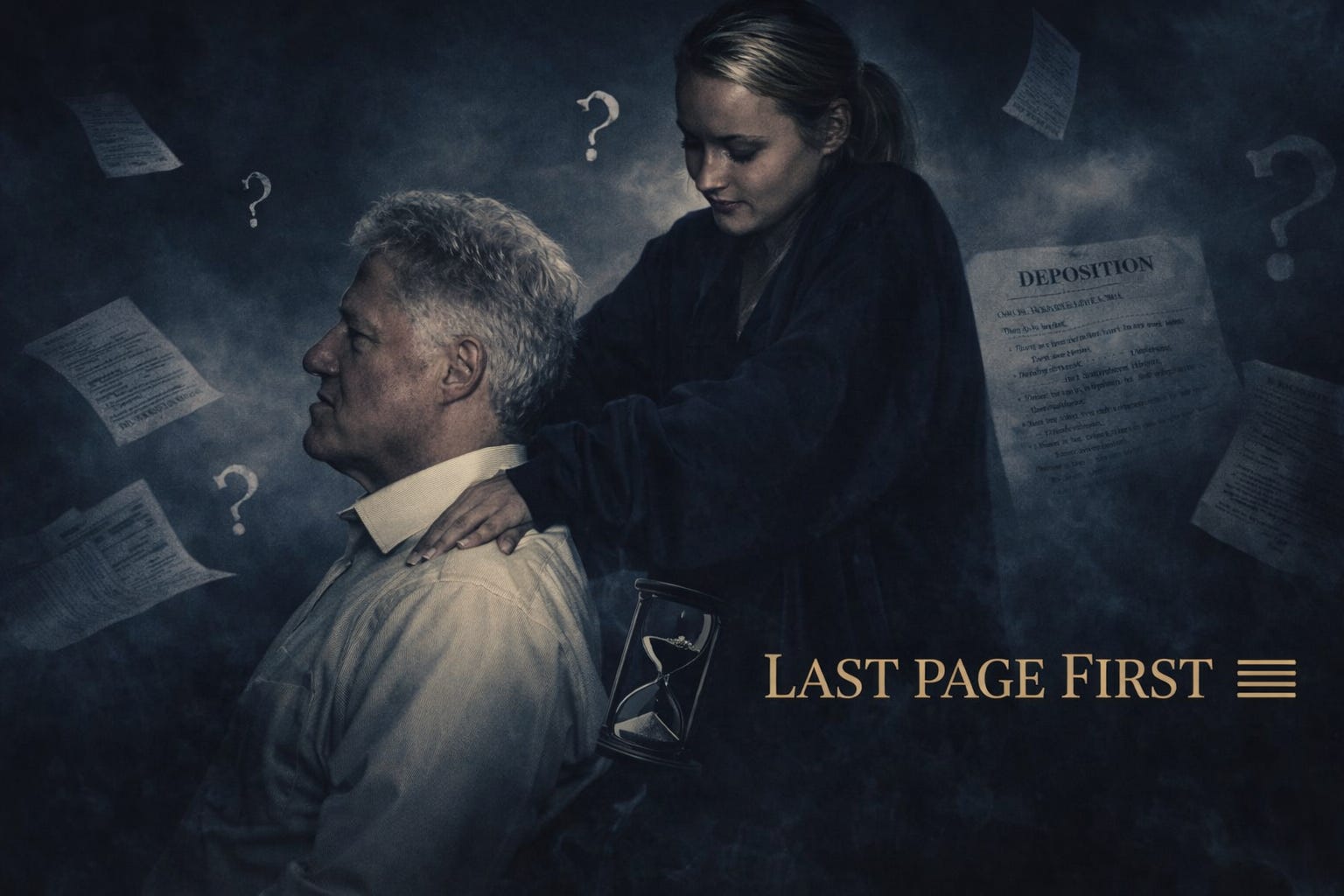
I watched the Bill Clinton deposition in full as I hope many others did as well. Not filtered through a headline or a partisan take, but the actual thing. The questions, the strange pauses, the even stranger answers. What I came away with wasn’t rage, exactly. It was something quieter and more unsettling: the feeling that I had just watched a very “intelligent” man work very hard at not knowing things.
Bill Clinton reportedly has an IQ of 156 and a near-photographic memory. He can recall the name of nearly every person he has ever met, the policy details of three decades of governance, and as it turns out, a great many things about the trips, the fundraisers, and the dinners. What he cannot seem to remember, with any consistency, is the flights.
That selective amnesia was on full display during his deposition before the House Oversight Committee. A deposition, it should be said, that the Clintons initially refused to give. Both Bill and Hillary Clinton fought their subpoenas and called them a partisan stunt. They relented only after the House moved toward a bipartisan contempt vote carrying a potential penalty of up to one year in prison and a $100,000 fine. It marked the first time a former president has ever been compelled to testify before Congress under subpoena. A precedent that Republicans noted proudly, and that Democrats immediately said should now apply equally to President Trump.
The deposition took place not on Capitol Hill but in Chappaqua, New York. Their lawyers negotiated the location specifically to avoid what one report described as the spectacle of a former president testifying under oath in Washington. Hillary testified the day before, for roughly seven hours. Her deposition is its own story, and it deserves its own piece. Bill’s session ran over six. He sat down, steadied himself, and delivered a prepared opening statement: “I saw nothing, and I did nothing wrong. No matter how many photos you show me, I have two things that at the end of the day matter more than your interpretation of those 20-year-old photos. I know what I saw, and more importantly- what I didn’t see. I know what I did, and more importantly- what I didn’t do.”
Then the questions began.
“He Was Like a Vacuum”
Clinton said he first met Epstein after leaving the White House, in 2001 or 2002, after a phone call from former Treasury Secretary Larry Summers. According to Clinton, Summers described Epstein as a successful investment advisor who had made a large commitment to brain research at Harvard. A man who wanted to discuss science and politics and would fly Clinton and his staff on long international trips so they could talk. Clinton called Epstein “an interesting man” and said their relationship was “cordial,” but he insisted they were not friends.
The early conversations ranged across derivatives markets, financial regulation, and the prospects for prosperity in Africa. “He was like a vacuum,” Clinton recalled. “He really wanted information.” The arrangement, as Clinton described it: an hour of conversation on economics and politics in exchange for use of Epstein’s plane for the foundation trips Clinton needed for his AIDS initiative.
Clinton said he eventually sensed Epstein was simply “checking a box.” Once he had gotten the information he wanted, the interest evaporated. The AIDS work meant nothing to him. “So we went our separate ways,” Clinton said. He described their acquaintance as brief and said he had long since cut ties before Epstein’s 2008 guilty plea to soliciting prostitution from an underage girl. “Had I known,” Clinton said in his opening statement, “I would have turned him in myself.”
He says the last time he flew on Epstein’s plane was 2003. Ghislaine Maxwell, whose prison interview was referenced during the deposition, offered a similar account. She told investigators she didn’t see Clinton being interested in Epstein. That Epstein was just a rich guy with a plane.
A Selective Memory
Here is what Clinton remembered clearly during the deposition.
He remembered which African nations were visited on a 2002 trip and why each stop mattered. He remembered walking in the funeral procession of the Moroccan king’s father. He remembered the intimate details of Norway’s HIV crisis near the ocean. He remembered Chris Tucker and Kevin Spacey imitating him on a plane. He remembered a hot tub at a hotel in Brunei, the specific reason he was there, who hosted him, and why he was exhausted when he got out. He remembered Ted Waitt, the reason he felt warmly toward Ghislaine Maxwell, and the fact that Chelsea and her husband also knew Maxwell was at the wedding.
In my view, you can watch the full deposition and decide for yourself. What followed felt like a pattern. Here is what Clinton could not remember.
Who the women on the flight logs were.
Whether he invited Epstein and Maxwell to the Moroccan king’s wedding.
Whether Ghislaine Maxwell organized the 2002 Africa trip.
Whether he attended a Maxwell fundraiser for his presidential library.
Whether a flight attendant named Chauntae Davies gave him a massage, or
Whether it was maybe just a neck rub.
Whether he had contact with the Department of Justice regarding Epstein in 2008.
Whether Epstein donated to the Clinton Foundation one day before his indictment.
Then there is the matter of Arnold Paul Prosperi. Lawmakers asked Clinton whether Prosperi, who visited Epstein over 20 times in jail, had ever spoken to him about those visits. It is not a random name on a list. Prosperi was a longtime friend of Clinton’s who had been convicted of embezzlement. In 2011, while Epstein was serving his sentence, Clinton commuted Prosperi’s own prison term to house arrest. The committee wanted to know if those two facts were connected. Clinton said he didn’t believe anyone ever told him about the visits.
That last detail about the Foundation donation is worth sitting with on its own. Clinton said he was “aware now” of the donation, meaning he learned of it during the deposition itself. When asked if someone solicited it, he said no. When asked why Epstein made it as investigators were closing in, Clinton offered simply: “Wouldn’t work.”
Epstein also visited the White House numerous times during the Clinton presidency. Photographs exist of the two men shaking hands at a White House Restoration Project reception in 1993, early in Clinton’s first term. Clinton told lawmakers he did not recall those interactions. “Epstein may very well have attended any of the many hundreds of White House events or receptions during my eight years in office and been photographed with me,” he said, “as were tens of thousands of individuals.”
The Lolita Express Question
When questioners asked Clinton if he had ever flown on the “Lolita Express,” his legal team erupted. They said they didn’t know what that was. The questioner rephrased calmly: had he ever traveled on Epstein’s plane? Had he ever traveled with both Epstein and Huma Abedin?
Clinton said he did not know.
Records included in the deposition indicated 26 flights. Clinton confirmed he believed Epstein was on most of them, and that Maxwell likely was too, though he said there would be a record of it.
When shown a fake passport found in Epstein’s safe bearing the alias “Marius Robert” alongside a photo that appeared to be Epstein, Clinton acknowledged it looked like him. The questioner raised the theory that Epstein may have been an intelligence operative and asked whether Clinton believed he had been the target of a honeypot operation.
“No,” he said.
The Photos
Repeatedly during the deposition, lawmakers showed Clinton photographs from the Epstein files released publicly by the Justice Department in December 2025 and asked if he had engaged in sexual activity with the women shown. Each time, he said no.
One photo in particular drew significant attention: a now-viral image of Clinton in a jacuzzi with a woman whose face is redacted. Clinton said the photo was taken during a stopover in Brunei on a foundation trip to Asia, at a hotel whose sultan, known to Clinton from his White House years, had invited him to stay. He said members of his traveling party were present. He said he got out of the pool exhausted and went to bed. He said he did not know who the woman was and denied any sexual activity.
A separate image shows Clinton in a pool alongside a woman who appears to be Ghislaine Maxwell and at least one other unidentified person. When asked if he recalled a young girl being visible in one of the images, Clinton said he believed everyone present was part of his traveling party and that to his knowledge no one there was under 18.
What struck me watching that exchange was not the denial. It was how small the room suddenly felt. How many photos there were. How matter-of-factly they were passed across the table.
The Girls on the Plane
A witness who testified before the committee stated that Maxwell appeared to be in a position of authority over young women on Epstein’s plane, directing them. Clinton was asked if he witnessed this.
“Well, I thought she was Epstein’s top aide and in charge of what happened,” he said.
“What did happen, Mr. President?”
“I don’t know. I already told you I didn’t see anyone do anything wrong. I thought they were flight attendants.”
He was then asked whether flight attendants typically wear tank tops and jeans on private planes.
“They don’t all wear uniforms on private planes,” he said.
Chauntae Davies, a flight attendant whose name Clinton mentioned multiple times and one of the few names he retained consistently, has publicly claimed she was herself a victim of Epstein, who used the word “masseuse” as cover for his abuse of young women. Clinton told the committee he was not aware at the time that Davies was a victim. When asked whether knowing it now made him think differently about the neck rub he received from her on one of those flights, he paused.
“She wants to know if I feel bad about it? Yes.”
I have thought about that answer more than almost anything else from that day. Not because it was shocking. Because it wasn’t. Because a woman was on that plane, a victim, and the most powerful man in the world got a neck rub and moved on.
Virginia Giuffre, the Island, and the Threats
Virginia Giuffre died by suicide in April 2025 in Western Australia, at the age of 41. She was one of Epstein’s most prominent accusers and spent years fighting for accountability. Other survivors have said her courage gave them the strength to come forward. Her posthumous memoir, Nobody’s Girl, was published in October 2025. She never got to see this deposition. I think about that a lot.
Clinton testified he has never been to Epstein’s private island. He said he did not know Giuffre and had never met her. He pushed back against claims from her diary, shared during the deposition by a family member, that she witnessed him on the island with two young women.
“Did she say that in her book?” he asked.
He was also confronted with an allegation that Clinton had walked into the Vanity Fair offices and threatened editors not to publish stories about Epstein.
He said: “No. Uh. No. Hell no. Not close. No.”
Maria Farmer, who reported her own abuse to the FBI and NYPD as far back as 1996, claimed personal knowledge that Clinton visited Epstein’s residence three to four times while he was a sitting president. That knowledge, she said, came from photographs Maxwell showed her and from conversations with staff. Clinton said he did not remember.
It is worth noting that the 2025 FBI document released as part of the Epstein Files compiled more than a dozen unverified sexual assault allegations, including against both Clinton and Trump. Clinton has never been accused of wrongdoing by law enforcement in connection with Epstein.
The People He Was Asked About
Questioners read Clinton a list of names and asked whether he had communicated about Epstein with each of them. The list was staggering in its breadth. A Who’s Who of finance, politics, royalty, and media: Bill Gates, Tony Blair, Prince Andrew, Alan Dershowitz, Ehud Barak, Lynn Forester de Rothschild, Larry Page, Howard Lutnick (now Secretary of Commerce), and dozens more spanning Wall Street, Washington, and several foreign governments.
He said he did not remember communicating about Epstein with most of them.
I want you to sit with that list for a moment. Not the names themselves, but what the list represents. One man, operating for decades, threading himself through the most powerful circles on earth. And according to nearly everyone asked: nobody saw anything, nobody said anything, nobody knew.
The Trump Thread
It would be incomplete not to mention Trump. Not to deflect from Clinton, but because the deposition touched on it directly and the contrast matters.
Epstein wrote in a 2011 email that Trump was “the dog that hasn’t barked,” and that an unnamed victim had spent hours at his home. In 2019, Epstein wrote that Trump knew about the girls because he had asked Maxwell to stop. Yet when the DOJ investigation was directed under the current administration, it targeted Clinton, Larry Summers, Reid Hoffman, and JPMorgan Chase. No Republicans were named.
Clinton voluntarily told investigators that Trump had mentioned in an early 2000s conversation on a golf course that he had had a falling out with Epstein over a land deal, something Trump has confirmed as the reason their friendship ended. Clinton said Trump gave him no reason at the time to believe he was involved in anything improper.
The top Democrat on the panel, Rep. Robert Garcia, noted after the deposition that since a new precedent had now been set, a former president compelled to testify under subpoena, it should apply equally to Trump. That demand has so far been met with silence.
What I keep coming back to is this: the question of who gets investigated and who doesn’t seems to have very little to do with the evidence. It has everything to do with who is currently holding the pen.
What We’re Left With
At the close of the deposition, Clinton had no closing statement. He noted simply that his memory was bad and that it would be difficult to recall specifics from more than 20 years ago.
Both Republicans and Democrats who sat in that room said Clinton was cooperative, that he answered every question. Rep. Anna Paulina Luna stepped out mid-session to tell reporters she had “no reason to believe he’s hiding the ball.” Committee Chair James Comer said Clinton showed “Southern people skills.” After it was over, Clinton left without speaking to the press. His wife, who had come out to speak to reporters after her own deposition the day before, was not there.
I have been thinking about what it means to watch something like this and feel nothing has been resolved. A man once known for an almost supernatural ability to absorb and retain information, policy minutiae, names, faces, the texture of a room, found himself unable to recall flight after flight, girl after girl, warning sign after warning sign.
Maybe that is true. Memory fails. Age diminishes even the sharpest minds. And to be clear: no one has accused Bill Clinton of a crime. He has not been charged with anything. Republicans on the committee said after the deposition that their attention was already shifting to other individuals.
But we are allowed to ask harder questions than that. We are allowed to ask how a trafficking network of this scale operated for this long, at the highest levels of politics, finance, and power. How so many intelligent, well-connected, well-protected people managed, collectively, not to notice. And we are allowed to ask whether the people who never noticed are really the right ones to be deciding when the investigation is over.
There were real victims. There are names in diaries. There are flight logs, photographs, and sworn testimony. Those things do not disappear because powerful men have bad memories.
Virginia Giuffre remembered everything. She spent years saying so, loudly and at enormous personal cost. She was called a liar. She was discredited. She was threatened. She kept going anyway. She died before seeing this deposition. Her memoir was published six months after her death.
The very least we can do is keep asking the questions she fought her entire life to make someone answer.
Last Page First is an independent investigative publication. Paid subscribers make the deep dives possible—FOIA templates, citation indexes, Document Room access, and subscriber discussion threads. If this piece reached you, share it. If you want to help keep it going, subscribe.
If you have documents, names, or anything relevant to an investigation, my inbox is open to everyone. Contact us here. Your name stays private unless you tell me otherwise.
All details in this article are drawn from the public deposition of Bill Clinton before the House Oversight Committee, and verified through reporting by CNN, NPR, CBS News, PBS NewsHour, Axios, and CBC News.