
Bill Richardson: The $50,000 Governor
The Paper Trail From a 2002 Donor List to a Federal Evidentiary Production — and Everything in Between

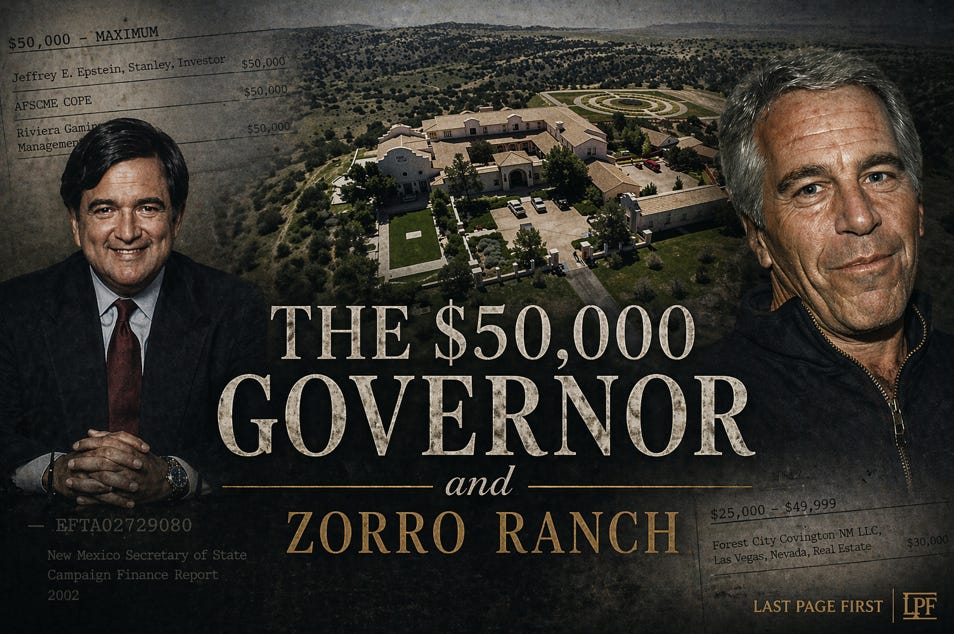
This is a part of the 49 Zorro Ranch Road Series
Part One | Victim Standalone | Part Two | Part Three | Part 4 | Part 5
Your subscription truly helps share this work.
If you have tips related to the Zorro Ranch and Epstein Investigation, contact:
https://nmdoj.gov/get-help/epstein-zorro-tips/
On September 19, 2016, a car carrying former New Mexico Governor Bill Richardson pulled up to East 71st Street in Manhattan, between Fifth and Madison Avenues, where a narrow 70 story townhouse rose from the pavement like a sealed vault — its facade a dense slab of dark limestone, the windows tall and evenly spaced, their glass giving back nothing. There was no number on the door, no plate, placard — just stone, a heavy wooden door, and a bell on the right hand side.
The building also had no doorman. Richardson’s aide, Brooke Lange, had emailed ahead to ask about the entrance. She was told to ‘have the Governor ring the bell on the right hand side,’ that a staff member would let him in. “This place is like a museum,” the response read “It used to be a school.”
The museum was 9 East 71st Street. The owner was Jeffrey Epstein. The occasion was dinner
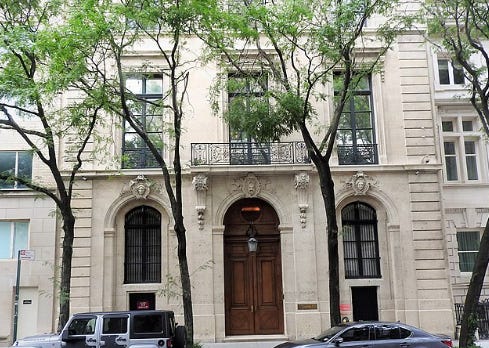
JE Townhouse 9 East 71st Street Source: Jim Henderson
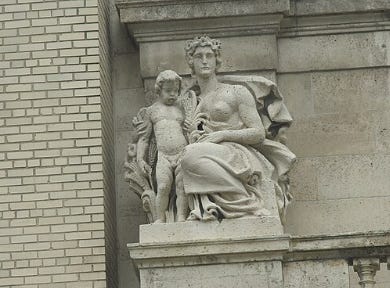
Balcony/ Frick Art Reference Source: Jim Henderson
Bill Richardson was not a naive man. He had served in Congress, in Bill Clinton’s Cabinet as Energy Secretary, as United States Ambassador to the United Nations, and as Governor of New Mexico for 2 terms. He had even run for President
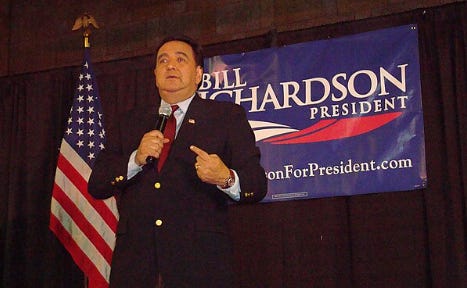
Bill Richardson on the campaign trail, 2008. He was running for President — he already knew Jeffrey Epstein. Source: Ryan Glenn
He was a prolific international hostage negotiator and one of the most decorated Democratic political figures of his generation — and he damn well knew exactly who Jeffrey Epstein was. By September 2016, the entire world did too. Epstein had pleaded guilty in 2008 to soliciting prostitution from a minor in Palm Beach, Florida, served 13 months in county jail under a non prosecution agreement that federal prosecutors would later describe as a ‘corrupt sweetheart deal’, and registered as a sex offender. The FBI’s internal documents would later establish that agents had been prepared to indict him on federal charges as far back as 2007 — before that deal was quietly brokered and the case was closed.
And Richardson went to dinner anyway!
Then he went back — through his emissaries, again and again, for more than a year — carrying a formal funding proposal, a personal video message from the Governor himself, and a request that Epstein support his diplomatic center with what his staff described as the urgency of a man who needed an answer before the year’s program decisions had to be made.
The dinner at 9 East 71st Street was not the beginning of their relationship but a continuation of one that had started at least 14 years earlier, when both men wrote checks to the same campaign, in the same election cycle, for the same amount, in a state where one of them owned a hundred thousand acre ranch and the other was trying to become governor.
This is the story of how Jeffrey Epstein and the Ratner family’s Forest City Enterprises bought political infrastructure in New Mexico — how that infrastructure served their real estate ambitions, and how the relationship was maintained across more than a decade and a half. It also covers how a former governor of the United States kept walking back through the door of a convicted sex offender’s townhouse to ask for money — even after his victims had already told the world what happened inside the home.
Every document cited in this investigation is drawn from the EFTA primary document production — the evidentiary record filed in federal court, in the Southern District of New York.
The Same Donor List
The document that starts this story is a March 2006 publication from the Albuquerque Tribune — a detailed breakdown of campaign finance contributions to Bill Richardson’s 2002 gubernatorial campaign, compiled from filings with the New Mexico Secretary of State and entered into the public record. It appears in the EFTA production at Bates range EFTA00203640 through EFTA02729107.
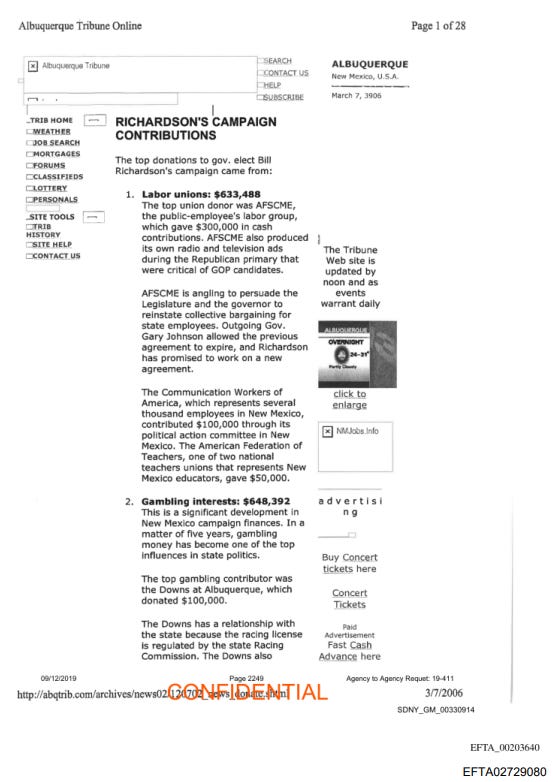
Buried in the contribution list, in the $50,000 tier alongside AFSCME’s political action committee and a Las Vegas gaming operation called Riviera Gaming Management, is a single entry: Jeffrey E. Epstein, Stanley, Investor. Fifty thousand dollars
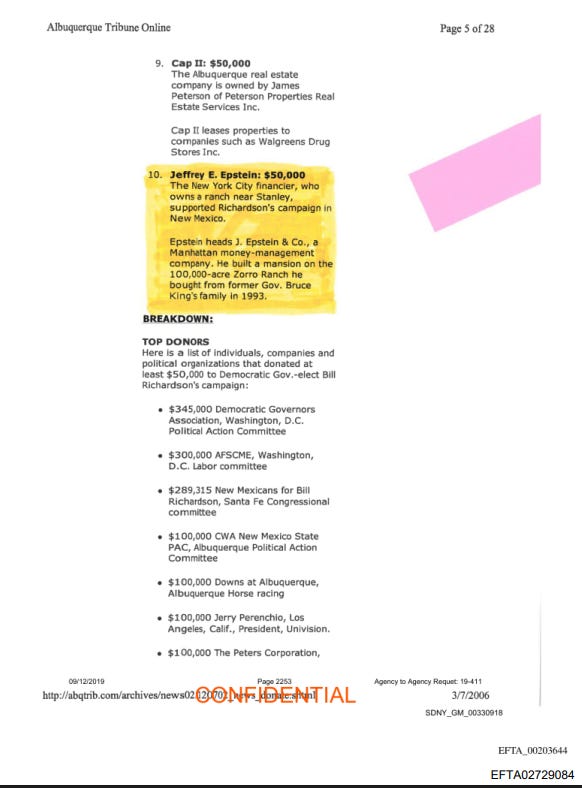
Stanley is a small community in Santa Fe County, New Mexico — the closest incorporated point to Zorro Ranch, the property Epstein had purchased from former Governor Bruce King’s family in 1993 and on which he had built a sprawling compound that federal investigators would later document in extraordinary and disturbing detail. By 2002, Epstein was not a casual New Mexico landowner. He was embedded in the state’s geography, its political economy, and its social infrastructure. He owned the land. He employed local staff. He had relationships with local officials. And in 2002, he wrote a 50k check to the man who was about to become governor.
Twelve lines below Epstein’s entry, in the $25,000 - $49,999 tier, is another: Forest City Covington NM LLC, Las Vegas, Nevada, Real Estate. 30, 000 dollars.
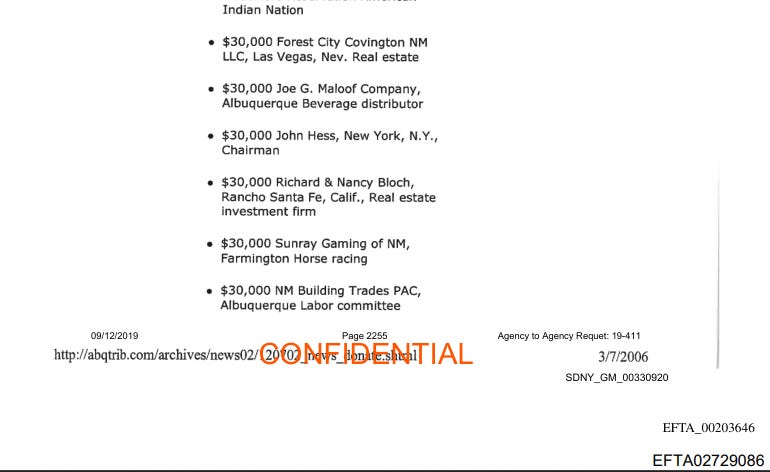
Forest City Covington NM LLC was the New Mexico subsidiary of Forest City Enterprises — the Cleveland based real estate conglomerate operated by the Ratner family: brothers Charles, Albert, and James — and their cousin Bruce, who ran the New York division known as ‘Forest City Ratner Companies.’ At the time of the Richardson donation, Forest City was actively pursuing what would become one of the most ambitious development projects in New Mexico history — Mesa del Sol — an 8000 acre ‘master planned community’ on the southern mesa of Albuquerque, adjacent to Kirtland Air Force Base.
Mesa del Sol required the state government, it required land deals, infrastructure commitments, tax incentives, rezoning approvals, and the active cooperation of the governor’s office. Forest City needed Richardson — so they gave him 30k.
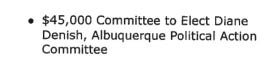
Also on that same list, in the $45,000 tier: the Committee to Elect Diane Denish — Richardson’s Lieutenant Governor, his chosen successor, funded directly from his own donor network. The money moved in a coordinated circuit. From Epstein. From Forest City. Into Richardson’s operation. Outward into Denish’s.
Epstein gave $50,000 to Richardson’s campaign. Forest City gave $30,000 to the same campaign. They appear just lines apart on the same donor list.
Campaign finance disclosures do not establish intent but hat they establish is fact — Jeffrey Epstein and Forest City Enterprises were both writing large checks to the same governor, in the same election cycle, at the precise moment Forest City needed that governor’s state government to greenlight their most ambitious project. At the precise moment Epstein needed that governor’s New Mexico to remain a place where no one asked questions about what was happening at his ranch.
Neither the Richardson campaign nor Forest City has ever been required to explain the coincidence publicly and neither has been charged with any violation in connection with these donations. The New Mexico Secretary of State’s filings are public record.
The EFTA production made them federal evidence.
Forest City, the Ratners, and the Epstein Network
To understand what Forest City’s presence in the Epstein production means, you have to understand who the Ratners were and how they operated.
Forest City Enterprises was founded in Cleveland in 1920 and grew across the 20thcentury into a multi billion dollar real estate empire with projects across the United States. By the 2000s, the company was operating through multiple regional subsidiaries, the most prominent of which was Forest City Ratner Companies in New York — run by Bruce Ratner. Bruce Ratner’s most famous project was Atlantic Yards in Brooklyn — a massive, politically contentious mixed use development anchored by the Barclays Center arena, home of the Brooklyn Nets. Atlantic Yards required enormous political capital, complex negotiations with the City and State, and relationships at the highest of levels to New York’s real estate and political infrastructure.
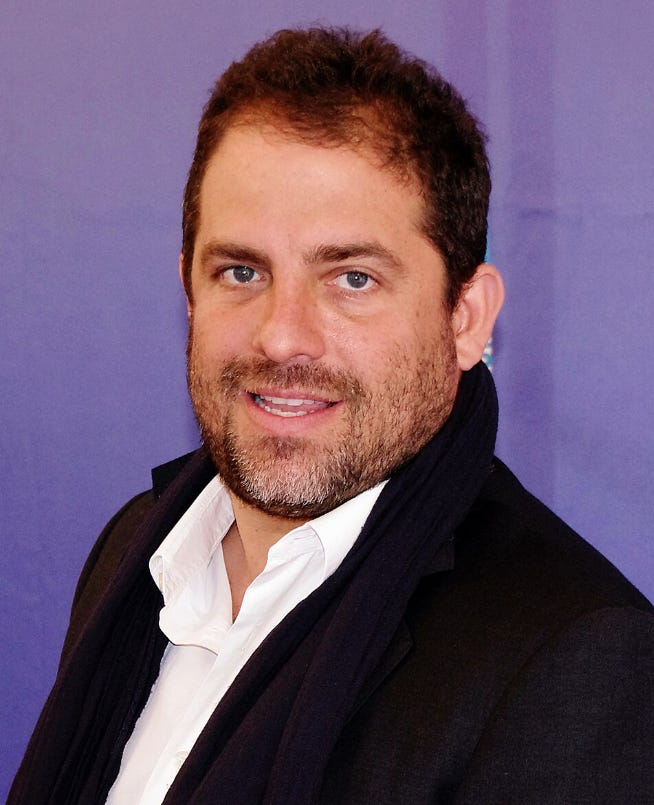
Brett Ratner at a panel discussion for the 2012 Tribeca Film Festival — David Shankbone
The Ratner family’s connection to the Epstein network is documented in the EFTA production at multiple levels and through multiple individuals.
The most direct connection is Brett Ratner — the Hollywood film director, not a Forest City principal but a member of the extended Ratner social orbit — who appears in Epstein’s personal contact list alongside Michael Ovitz, Tom Barrack, Michael Bay, and Dan Adler. Brett Ratner’s former fiancee — Romanian model Alina Pascau — is documented in a May 2005 New York Post Page Six item as a former girlfriend of Epstein who obtained a modeling contract with Les Wexner’s Victoria’s Secret brand through Epstein’s introduction. The Post reported that Epstein paid for her to live in what they described as ‘high style.’ When that relationship ended, she dated Brett Ratner.
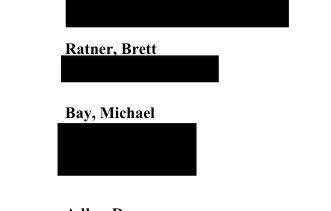
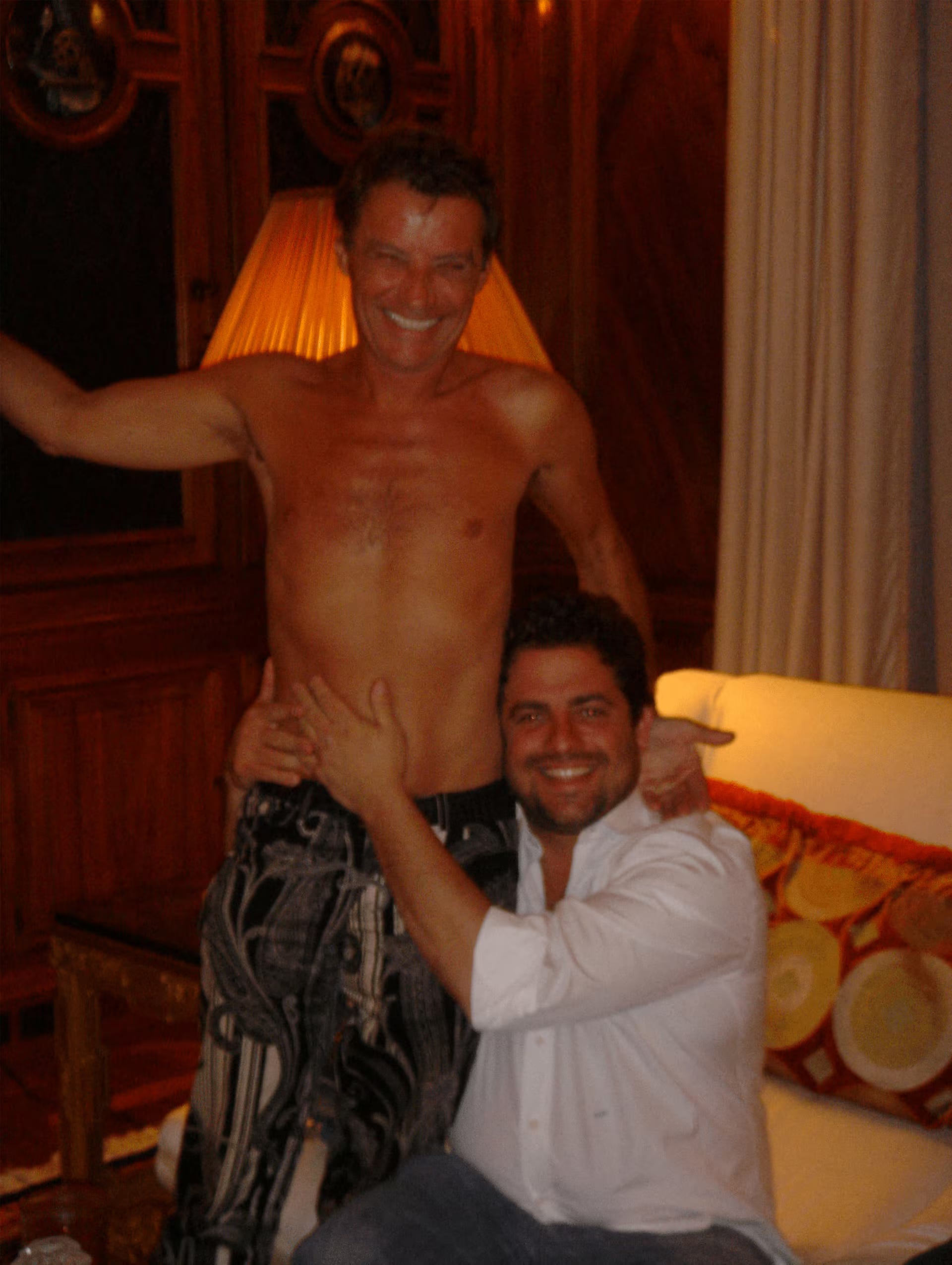
American film director Brett Ratner poses with Jean-Luc Brunel. via U.S. Justice Department
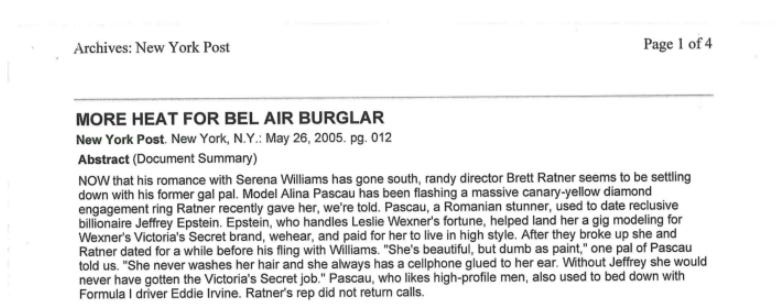
The more significant corporate connection is documented in a May 2012 email chain that appears in EFTA02017848 through EFTA02017850 and again at EFTA00934747 through EFTA00934749. The emails involve a real estate developer named David Mitchell of Mitchell Holdings LLC, operating from 815 Fifth Avenue in New York. Mitchell was a regular correspondent with Epstein — he emailed jeevacation@gmail.com, Epstein’s personal account, on multiple occasions about real estate projects and business introductions.
On May 16, 2012, Mitchell forwarded to Epstein’s personal email account a correspondence chain with James Ratner — a senior executive at Forest City Enterprises — regarding a waterfront development site in Long Island City, Queens. The property was described as 8 acres on the southern peninsula called Hunters Point South West, all on the water facing the United Nations, adjacent to the TF Cornerstone site, with zoning for 1.5 million square feet of mixed use and a 421 a tax abatement. A friend of Mitchell’s who was not in the real estate business owned the site and was looking for the right joint venture partner. James Ratner responded to the introduction with enthusiasm and professionalism, writing that he would forward the opportunity to MaryAnn Gilmartin, who he described as the head of development for Forest City’s New York office, responsible for the New York Times Building, the Gehry Building, and Atlantic Yards, and therefore the top person on development for them in New York.
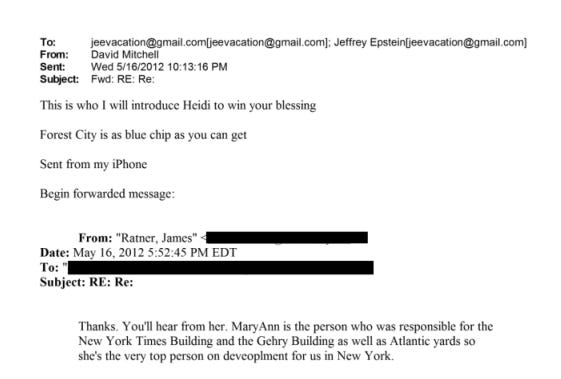
— EFTA02017848
Mitchell forwarded the entire chain to Epstein with a single subject line: ‘This is who I will introduce Heidi to win your blessing. Forest City is as blue chip as you can get.’
The phrase “win your blessing” is not really a casual expression. It is a direct statement that a real estate introduction involving Forest City Enterprises and a Long Island City waterfront development site required Jeffrey Epstein’s approval before it could proceed. Mitchell was not informing Epstein of the introduction — he was seeking his sanction. Forest City, one of the largest real estate developers in the United States, was being brought into a deal through Epstein’s network, and Epstein’s blessing was the prerequisite. Let that hit.
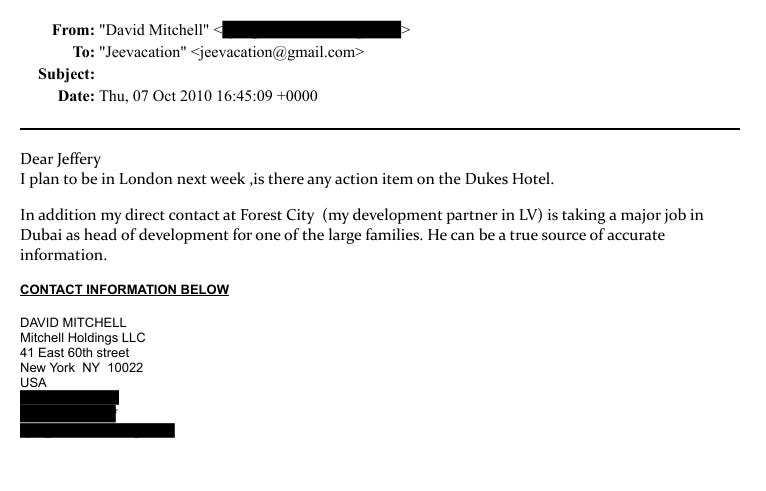
David Mitchell’s relationship with Forest City is separately documented in the EFTA production. In an October 2010 email to Epstein (EFTA00755576, EFTA02420212), Mitchell wrote “my direct contact at Forest City (my development partner in LV)” — Las Vegas — is taking a major job in Dubai as head of development for one of the large families. That contact, later identified as Dimitri Vazelakis, was described as a source of real intelligence on the ground in the Middle East. Mitchell forwarded that introduction to Epstein as well, suggesting he be connected to Vazelakis for access to the Majid Al Futtaim Group. Forest City’s personnel were being routed into Epstein’s network as intelligence assets and business contacts.
And then there is the relationship between Lesley Groff and Kelly Ratner.
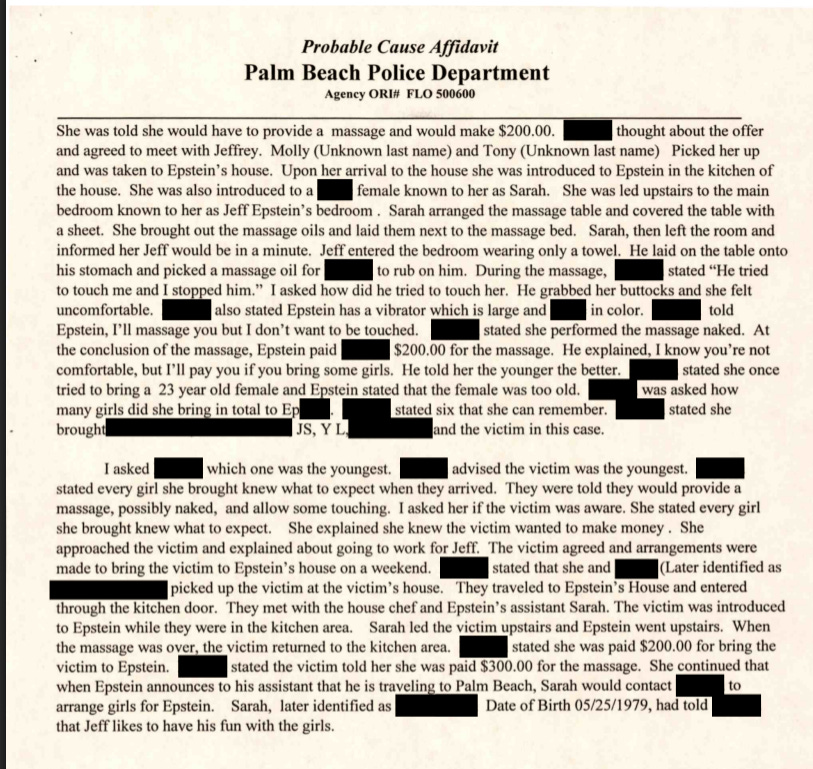
Lesley Groff was one of Jeffrey Epstein’s most trusted personal assistants. You can read our full profile on her here. She is documented extensively in the EFTA production as a scheduler, fixer, and coordinator of Epstein’s personal calendar. She arranged travel, meetings and contacts. She was one of four women indicted alongside Ghislaine Maxwell in the original superseding indictment, though she was ultimately not charged. Palm Beach police probable cause affidavits (EFTA02855412) identify “Sarah” — a woman whose date of birth matches Groff’s — as the person who arranged massage tables in Epstein’s bedroom, briefed girls on what to expect, and contacted recruiters when Epstein announced he was traveling to Palm Beach.
Kelly Ratner is documented in the EFTA docs through a series of personal emails with Lesley Groff spanning July through October 2016 — the same period during which Richardson was being scheduled for dinner at Epstein’s townhouse. The emails (EFTA00322451, EFTA00322481, EFTA00320155, EFTA02192757) show the 2 women as close personal friends — taking fitness classes together at the YMCA, arranging playdates for their children, attending each other’s social events and gatherings. Groff refers to Epstein as “boss” in one exchange while coordinating childcare around his schedule. Kelly Ratner signs her emails with friendly warmth: “Xo, Kelly.”
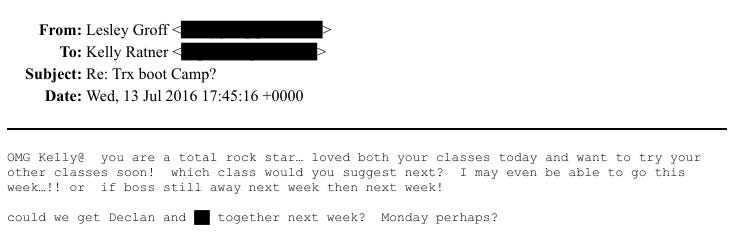
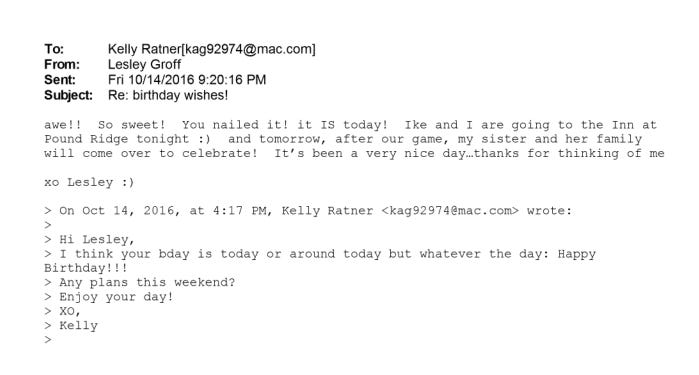
The emails establish that while Groff was scheduling a sitting governor’s dinner at Epstein’s home and forwarding funding proposals from his diplomatic center to Epstein’s personal inbox, she was also maintaining a close social friendship with a member of the Ratner family network. The personal and the professional were not separate spheres in Epstein’s world — they were the same.
The Governor’s Long Relationship
The 2002 campaign donation was not an isolated transaction — it was the foundation of a relationship that the EFTA documents show persisted across at least seventeen years, maintained through personal meetings, calendar coordination, funding solicitations, and legal maneuvering that accelerated the moment Epstein was arrested.
The next documented contact between Richardson and Epstein in the EFTA production comes from September 2011 — 9 years after the campaign donation and 3 years after Epstein’s 2008 conviction and sex offender registration. On September 19, 2011, an Epstein assistant emailed Epstein’s personal account with the subject line “Gov. Richardson” and the following message: “Gov. Richardson is asking if he could see you at 10:30PM on Thurs or at 10:30AM on Friday. Please advise what you prefer.”
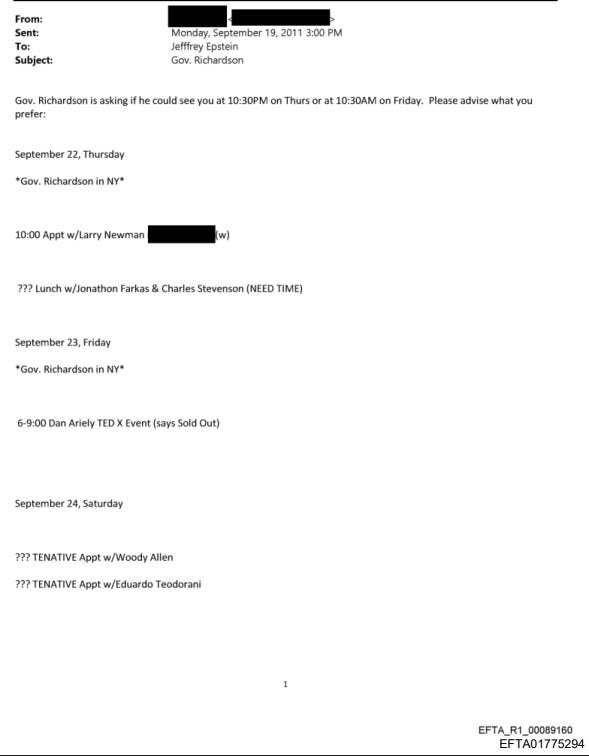
The email was routine in its tone — a scheduling inquiry, no different in format from a dozen other appointment requests in Epstein’s calendar. Richardson was requesting a meeting with Epstein and JE’s office was accommodating the request. The Governor was offering two time slots and the choice was Epstein’s. It seems a lot of choices were.
The September 2011 calendar entry in which that email appears places Richardson alongside a tentative appointment with Woody Allen, a lunch with Jonathan Farkas and Charles Stevenson, and a TEDx event featuring Dan Ariely. The company Epstein kept was varied and prominent. A former governor of New Mexico, a filmmaker, business figures, academics. The meetings were social, professional, and — in Richardson’s case — ongoing.
5 years later, in September 2016, the relationship had not diminished. On September 2, 2016, Brooke Lange of the Office of Governor Bill Richardson emailed Epstein’s assistant asking whether Epstein might be available for a visit on September 6, 7, 8, or September 18, 19, or 20. The inquiry came from Richardson’s office, not from Epstein’s. Richardson was the one asking to visit this time:
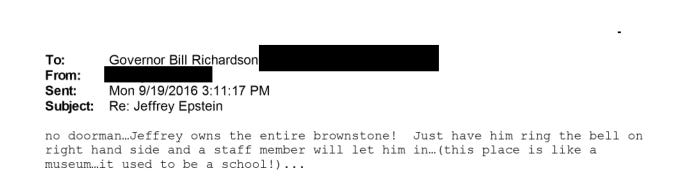
Epstein confirmed he would be available Monday, September 19. Then, onthat date, Brooke Lange emailed to confirm the dinner and to ask for the address. She was told: 9 East 71st Street between Fifth and Madison, there was no doorman, ring the bell on the right hand side. She was told that a staff member would let him in. They add “this place is like a museum. It used to be a school.”
The building at 9 East 71st Street was not a museum but it was a 70 story, 40 room Beaux- Arts mansion that Epstein had acquired for less than 10 million dollars from The Pilgrims of the United States, a private society, and had converted into his primary New York residence. The interior — described by multiple witnesses in federal court filings — was a ‘monument to Epstein’s predatory interests.’ Photographs of young women everywhere, a massage table in the upstairs bedroom, a communications infrastructure that investigators would spend years attempting to fully document. Bill Richardson walked into this building on September 19, 2016, for dinner and 8 years after Epstein had pleaded guilty to soliciting a minor for prostitution.
Richardson walked into 9 East 71st Street on September 19, 2016 — eight years after Epstein’s conviction. He was not there as an investigator or a journalist — he was there for dinner.
What was discussed at that dinner is not documented in the EFTA production. What is documented is what happened immediately afterward:
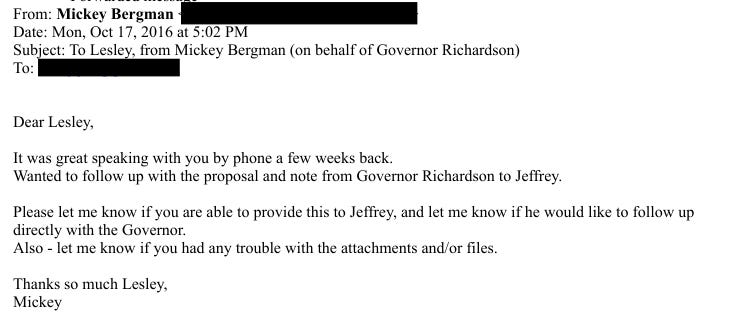
On October 17, 2016 Mickey Bergman — Vice President of the Richardson Center for Global Engagement( Richardson’s personal diplomatic and humanitarian organization) — sent a formal funding proposal to Lesley Groff at Epstein’s office. The subject line was “To Lesley, from Mickey Bergman (on behalf of Governor Richardson).” The email noted that it had been great speaking with Groff by phone a few weeks earlier and that he was following up with the proposal and a personal note from Governor Richardson to Jeffrey. The attachments included a formal funding proposal for the Richardson Center, multiple supporting documents, and a video file titled “Gobernador New Mexico.avi” — a personal video message from Bill Richardson to Jeffrey Epstein, recorded specifically for this solicitation.
On October 27, 2016, Bergman followed up by phone, and Groff forwarded the entire package to Epstein’s personal inbox (EFTA00438163 - EFTA00461948). Her forwarding note to Epstein read: “Mickey called to follow up on this on behalf of Governor Richardson... Mickey says you spoke to the Gov. about this when he was here last.”
The phrase “when he was here last” is the documentary confirmation that Richardson and Epstein had discussed the Richardson Center funding during the September 19 dinner. The proposal was not unsolicited. Epstein had apparently indicated, during dinner at 9 East 71st Street, that he might be willing to support Richardson’s organization. Richardson sent the formal proposal within four weeks.
By October 31, 2017 — a full year after the initial proposal — an Epstein assistant reminded Epstein directly in an internal note: “you told Gov. Richardson you would support his center but for tax reasons it will be done in November... (Mickey Bergman is assistant... we may be hearing from him soon).” Epstein had made a verbal commitment to Richardson. His own staff was tracking the promise and anticipating the followup call.
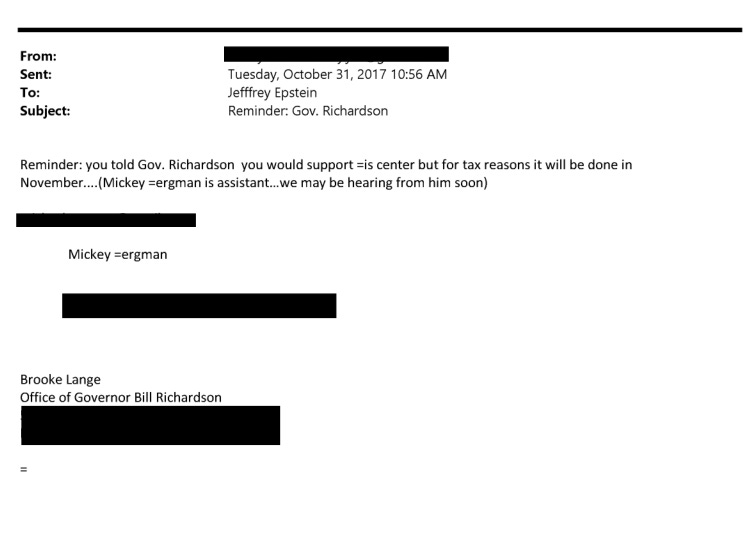
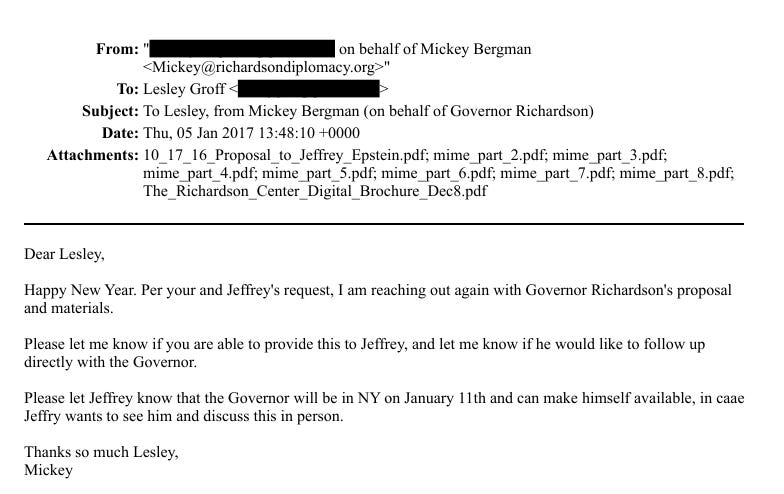
The follow up call is documented in quite extraordinary detail. On January 5 2017, Bergman emailed Groff again, noting “per your and Jeffrey’s request” — confirming that Epstein’s office had specifically asked Bergman to resubmit the proposal. Richardson would be in New York on January 11th and could make himself available in case Jeffrey wanted to discuss it in person. A new attachment had been added to the package. An updated December 2016 brochure, prepared specifically for the Epstein solicitation:
On January 30, 2017, Bergman emailed again (EFTA00443982): “Wanted to check in to see if Jeffrey had a chance to look over the proposal. I hope I’m not bothering you with these, and if Jeffrey decided not to do this, that is fine, but Governor Richardson wanted me to follow up, as we need to make program decisions for the year.”
On January 31, 2017, Lesley Groff responded to Bergman: “Hi Mickey. Jeffrey would be happy to speak with the Gov. Does today work? Jeffrey is pretty open at the moment.” A phone call was scheduled. Bergman confirmed the Governor would be on short flights but would call. Groff provided a number. Richardson called. Epstein was on another line. Richardson said he would call back in ten minutes. He did not reach Epstein. Groff emailed Bergman to have Richardson try again at 2pm (EFTA00444031).
The entire phone call sequence is documented in the EFTA production across multiple email threads. A former two term governor of New Mexico and former United States Ambassador to the United Nations was playing phone tag with Jeffrey Epstein, trying to reach him on a January afternoon to discuss a funding proposal for his diplomatic center, while Epstein’s scheduler coordinated the connection in real time.
The Arrest, the Lawyer, & the Scramble
On July 6, 2019, Jeffrey Epstein was arrested at Teterboro Airport in New Jersey as his private plane landed from Paris. He was charged by the Southern District of New York with sex trafficking of minors and conspiracy to commit sex trafficking. The indictment covered conduct at his Palm Beach residence and his Manhattan townhouse. The investigation that produced that indictment had access to the EFTA document production — the emails, the calendars, the contact lists, the scheduling chains that form the evidentiary foundation of this investigation.
Within weeks of the arrest, the SDNY received a communication from a lawyer named Jeff Brown of the law firm Dechert LLP. Brown was representing Bill Richardson. He was contacting the office proactively, before Richardson had been contacted by investigators, to offer Richardson’s assistance with the investigation and to negotiate his status.
The internal SDNY email chain documenting this contact (EFTA00032235 - EFTA00032236) is a window into how quickly Richardson’s legal team moved and how unprepared the prosecutors were for the contact. On August 21, 2019, an AUSA forwarded an inquiry from the Public Affairs office: Richardson had issued a public statement claiming that his lawyer had been informed by the AUSA responsible for the case that “Governor Richardson is neither a target, subject, nor witness in the case and that there is no allegation against Governor Richardson that the government is actively investigating.” The statement concluded: “It’s fair to conclude that the federal prosecutors investigating this matter do not believe the Governor participated in or witnessed the criminal activity Jeffrey Epstein is alleged to have committed.”
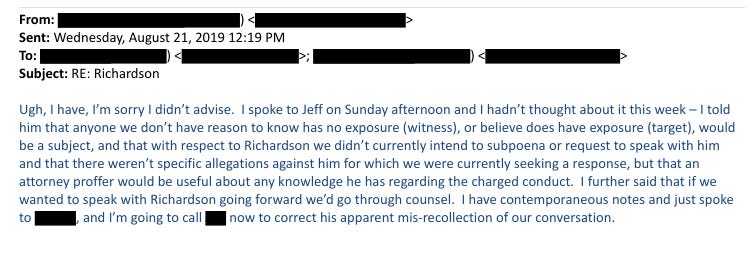
The forwarding AUSA added a blunt question to colleagues: “Has anyone talked to Jeff Brown and is this accurate?”
The response from another AUSA was more blunt: “I’ve never spoken to anyone who represents Bill Richardson. Have you guys? Am I missing something?”
A third AUSA then explained that she had spoken to “Jeff” — apparently Epstein’s attorney — and had told him that anyone they didn’t have reason to know had exposure would be considered a subject, and that with respect to Richardson specifically, they did not currently intend to subpoena or request to speak with him and that there were no specific allegations against him for which they were currently seeking a response. She had further said that an attorney proffer would be useful if Richardson had any knowledge of the charged conduct. She noted she had ‘contemporaneous notes’ and was going to call to correct what she described as an ‘apparent misrecollection of their conversation.’
‘I’ve never spoken to anyone who represents Bill Richardson. Have you guys? Am I missing something?’ — SDNY prosecutor, August 21, 2019
The SDNY scramble is revealing in several respects. First, Richardson’s legal team moved faster than the prosecutors expected — fast enough that the office was fielding questions from the Public Affairs division about statements Richardson had already made to the press before the relevant AUSAs had even established among themselves what had been communicated. Second, the internal confusion about who had said what to whom suggests that Richardson’s lawyer had been working channels within the SDNY that were not fully coordinated across the prosecution team. Third, the reference to an “attorney proffer” — an offer by a witness to provide information through their lawyer in exchange for some form of protection or clarity on status — is the language of exposure management, not innocent bystander cooperation.
Richardson publicly stated that he hoped the investigation continued so that Epstein’s victims could ‘have their day in court.’ He did not disclose that he had been to Epstein’s home for dinner literally 8 months before Epstein’s arrest, that he had been soliciting Epstein for funding for his diplomatic center through multiple email chains and phone calls throughout 2016 and 2017, or that his staff had maintained direct communication with Epstein’s personal assistant across a period of years.
Bill Richardson died in September 2023, he was never charged in connection with the Epstein investigation.
The Internal Alert
On November 6, 2017, a search alert was triggered within Epstein’s communications system. The alert carried the subject line: “Did JE/Rich donate to Gov. Richardson? Mickey Bergman.”
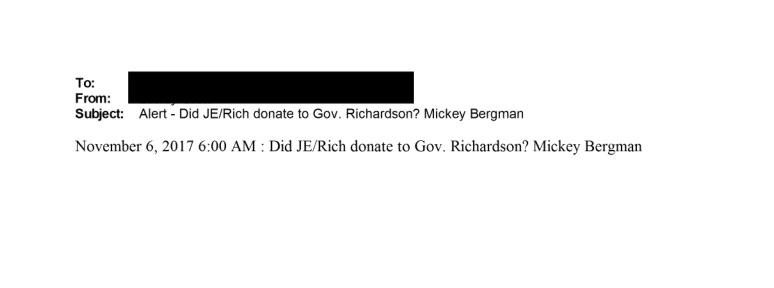
The alert was generated by a monitoring system tracking communications related to specific search terms. The combination of terms — Epstein’s initials, “Rich” (possibly a second donor, possibly a shorthand for Richardson himself), the donation question, and Bergman’s name — suggests that someone within Epstein’s operation was actively monitoring the Richardson relationship for legal or financial exposure. This alert was generated in November 2017, one year after the initial funding proposal and two months after Harvey Weinstein’s sexual abuse allegations broke publicly, inaugurating the period that would become the Me Too reckoning.
The timing is significant here./ Epstein’s team was paying attention to who had been connected to him financially, who was asking for money, and what the documentary trail looked like. A former governor of New Mexico had been soliciting Epstein for donations. Epstein had apparently verbally committed to supporting his center. The question “Did JE/Rich donate to Gov. Richardson?” may have been an internal audit of financial exposure — an attempt to establish whether money had already moved, what the disclosure obligations were, and what the legal footprint of the Richardson relationship looked like.
What the EFTA documents stablishes is that the relationship was close enough, sustained enough, and financially entangled enough that Epstein’s own staff was running internal searches on it.
The Metrotech Connection
The thread connecting Forest City Ratner to the Trump Organization in the EFTA production runs through a single business plan document submitted to Epstein’s inbox from 666 Fifth Avenue — the address of Kushner Companies — by a lawyer and developer named Michael Bailkin of Arete Strategic Development (EFTA01197500 through EFTA01197511)
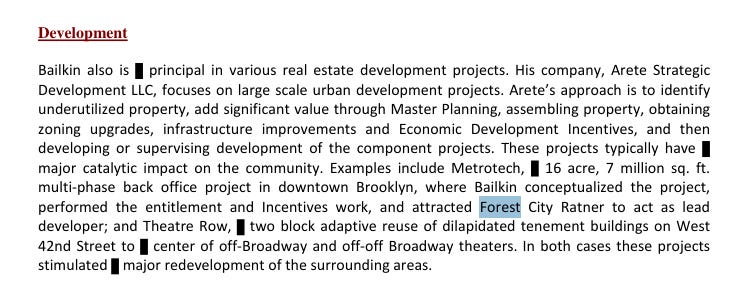
Bailkin’s biography, included in the business plan, is a document of extraordinary specificity about the overlap between Forest City Ratner, the Trump Organization, and New York’s economic development infrastructure. Bailkin describes his Incentives Practice as national in scope, with significant completed assignments in New Mexico and other regions. His major projects in New York, he notes, include Metrotech — described as a 17mil sqaure ft re-development in downtown Brooklyn for ‘back office space’ — and a broad range of projects for local and national developers that he lists explicitly as: Forest City Enterprises, Vornado, Related, and the Trump Organization.

Bailkin’s biography further describes his role in the Metrotech project specifically: he conceptualized the project, performed the entitlement and incentives work, and attracted Forest City Ratner to act as lead developer. Metrotech is one of the signature Forest City Ratner projects in Brooklyn, a precursor to Atlantic Yards, developed through exactly the kind of public/private partnership and economic development incentive work that Bailkin describes as his specialty.
The Arete business plan was submitted to Epstein from 666 Fifth Avenue — the building that Jared Kushner’s family company had purchased in 2007 for 1.8 billion dollars, the highest price ever paid for a New York office tower at the time, and the property whose near collapse would later drive the Kushner family’s desperate search for a Qatar linked bailout during the Trump administration. The plan itself proposed a $15 million capital raise for urban land development across Gateway cities, with Forest City Enterprises named among the developer relationships the principals would bring to the venture.
The docs do not establish that Trump was personally connected to the Epstein network through Bailkin or through Forest City, but, what it does establish is that the economic development infrastructure that bound Forest City Ratner to New York’s political and real estate establishment — the same infrastructure that produced the Richardson campaign donations in New Mexico, the same network through which David Mitchell was routing Forest City introductions through Epstein’s blessing — was visible at 666 Fifth Avenue and was being pitched directly into convicted sex offender and paedophile, Jeffrey Epstein’s private inbox.
The EFTA production is not finished, nor is the investigation. The documents that exist establish a pattern to which we can see the outline clearly. What remains in the unrendered attachments, the redacted exhibits, and the Bates ranges not yet reviewed may establish more.
Truth is, this work takes all of us.
If this investigation has been useful to you — if it gave you something to think about, something to share, something to act on — consider supporting Last Page First. Independent investigative journalism doesn’t have institutional backing behind it. It has the readers ♥
Have a tip? A lead you want to share?
This work is entirely reader supported. No grants, no advertisers, no editorial board — just primary documents and the time it takes to read them. If you want to keep this going, donating is the most direct way to help. Thank you.
Sources
Epstein’s $50,000 donation to Richardson’s gubernatorial campaign — EFTA00203640
Forest City Covington NM LLC’s $30,000 donation to the same campaign, same cycle — EFTA00203646
James Ratner / MaryAnn Gilmartin introduction being routed through Epstein’s approval — EFTA02017849
Brett Ratner in Epstein’s personal contact list — EFTA00577390
Alina Pascau as Epstein girlfriend / Ratner fiancée / Victoria’s Secret connection — EFTA01334062
Lesley Groff and Kelly Ratner personal friendship July-October 2016 — EFTA00322451, EFTA00322481, EFTA00320155
Groff referring to Epstein as ‘boss’ in Ratner email chain — EFTA00322451
Richardson 2011 meeting request through Epstein’s scheduling system — EFTA01775294
October 2016 formal funding proposal from Richardson Center to Lesley Groff — EFTA00461948, EFTA00438158
Groff note confirming Richardson discussed funding with Epstein at September dinner — EFTA00438163
January 2017 phone call coordination between Richardson and Epstein — EFTA00443982, EFTA00444031
‘Per your and Jeffrey’s request’ confirmation Epstein’s office solicited resubmission — EFTA00442436
November 2017 internal alert: ‘Did JE/Rich donate to Gov. Richardson?’ — EFTA02228567
August 2019 SDNY internal email chain on Richardson lawyer contact — EFTA00032235, EFTA00032236
Palm Beach Police probable cause affidavit documenting ‘Sarah’ — EFTA02855412
Mesa Del Sol is where ABQ Studio was located, Netflix purchased the Studio in 2018.
Mesa Del Sol originally owned the Amphitheater. While the Isleta Pueblo sponsored it for over a decade, it is important to note the venue has had multiple names since opening in 2000, including Mesa del Sol Amphitheater, ABQ Journal Pavilion, and Hard Rock Albuquerque presents: The Pavilion. The name is changing once again. The casinos like Isleta donate to campaign funds. They are big purchasers of liquor and they also donate to political campaigns, and there are 23 which are run by the tribespeople/Native Americans. Gamble against the house (give them your money) and then the house donates significantly to candidates; along with liquor distributors like Premier who also make SIGNIFICANT DONATIONS TO political candidates. So who really decides the elections? The people with the money decide who you can choose.
Don’t get me started to Netflix who was allowed to film movies while the entire state of New Mexico had the strictest lockdowns. Apparently making movies was ESSENTIAL during COV…… ID.
Amazing work! Thank you for your efforts