
Epstein Victim Testimony: She Was 13 Years Old
Epstein's lawyers put her in a room for nine hours - She still told the truth.

This piece contains sworn testimony describing the sexual abuse of a thirteen year old child.
Reader discretion is advised.
Your subscription truly helps share this work.
Have a tip? A lead you want to share?
This work is entirely reader supported. No grants, no advertisers, no editorial board — just primary documents and the time it takes to read them. If you want to keep this going, donating is the most direct way to help. Thank you.
Case No. 9:08-cv-80994 (S.D. Fla.). Filed September 10, 2008. Case documents hosted in the DOJ Epstein Library (justice.gov/epstein). Settlement terms, if any, remain sealed. No public record of criminal charges related to this victim.
She only weighed eighty pounds
That detail is horrifying, and I keep coming back to it. Not the marble floors of the Palm Beach mansion, not the cab ride across the bridge and not the massage table, or the robe, or what came after. This 13 year old girl weighed only eighty pounds. A child so small she knew — even at thirteen — that there was no version of this where she could run.
She knew that before he even said a word.
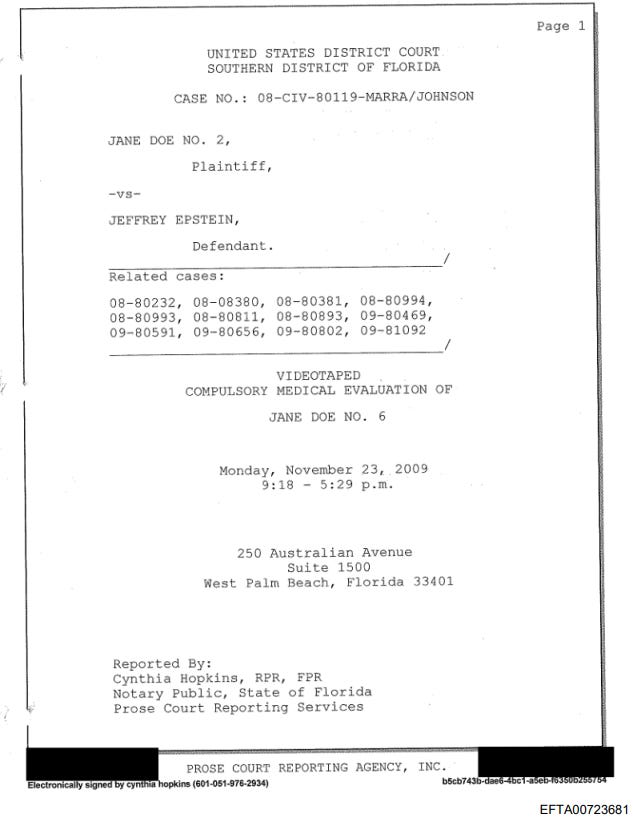
Cover page — Videotaped Compulsory Medical Evaluation of Jane Doe No. 6. Case No. 08-CIV-80119-MARRA/JOHNSON.
November 23, 2009. This examination was commissioned by Jeffrey Epstein's legal team. She was 19 years old, 13 when he abused her. — EFTA00723681
The document I am publishing today is not a news article, not a summary. It is a transcript — 204 pages of sworn testimony taken on November 23, 2009, in West Palm Beach, Florida. The deponent is identified only as Jane Doe No. 6. She was nineteen years old when she sat in that room but she had been only thirteen when Jeffrey Epstein abused and raped her.
The evaluation was commissioned by Epstein’s own legal team. The doctor asking the questions — Dr. Ryan Hall, M.D. — was retained by the defense. This was not a safe space, at all This was not a therapist’s office. This was a forensic examination designed to find cracks in her story, inconsistencies in her history, reasons to dismiss her.
But, they did not find any.
“He didn’t need to threaten me. He was bigger than me, and he was — I was a child, you know.”
She answered every question for nine hours straight. She talked about her parents, her neighborhood, her fights at school, her father’s drinking, the car accident on I-4 that still makes her grip the passenger seat. She talked about the boyfriend who shot himself in front of her house when she was sixteen. She talked about cutting herself, about Xanax and marijuana and depression that swallowed her whole.
And then, somewhere around page 108, she started talking about August 8, 2004.
What Happened
She remembered the date because of her friend Melissa. Melissa’s birthday was 8/8/88 — four eights — and she was turning sixteen that day. She remembered it because Melissa had gotten into a car accident on her birthday. That is how memory works when you are thirteen and something happens that will follow you for the rest of your life — you anchor it to something else, something ordinary — because the event itself is too large to hold alone.
A girl she knew — referred to in the transcript as E.W — had approached her. E.W told her they would go to ‘some guy’s house,’ give him a massage, maketwo hundred dollars. A mutual friend, another Jane Doe, told her it would ‘be okay.’ She had been there before. She went all the time.
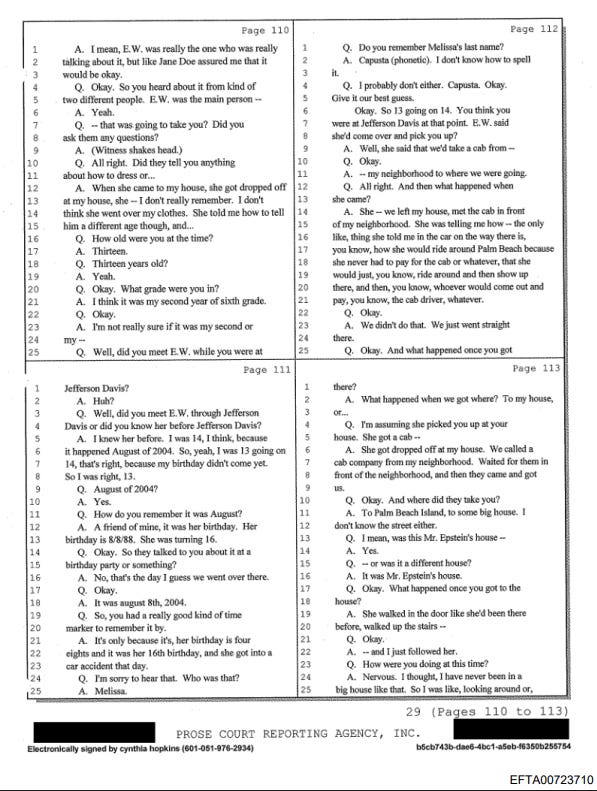
Her description of the room — sworn testimony.
— EFTA00723710
E.W told her to lie about her age.
She was only thirteen years old.
They took a cab from her neighborhood to Palm Beach Island. When they arrived, E.W walked into the house like she had been there before — because she had. They went up the stairs and into a room with a massage table, a sauna, and another door that led to an office.
Epstein was already lying on the table.
E.W started rubbing his back and less than a minute later, she left the room.
And then it was just the two of them.
“I was by myself. I didn’t know what to do. I didn’t feel like I could say yes... tell him no and then try to run? I mean, like, you know, I weighed like 80 pounds. I mean, I was terrified.”
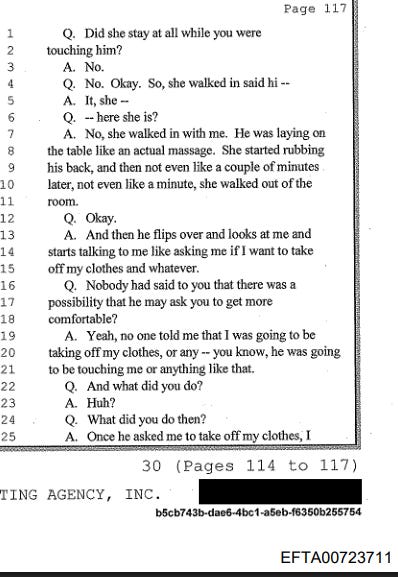
The core testimony. This is the most critical evidentiary page in the document.
— EFTA00723711
He flipped over, looked at her, and asked her if she wanted to take off her clothes.
She undressed and did not resist, knowing she stood no chance. She kept her underwear on — she stood there, frozen, while he touched her chest and ‘pleasured himself’.
She did not scream, she did not run. She stood there frozen — stuck — in her own words, because that is what children do when a powerful adult has engineered a situation where every exit has already been removed from them.
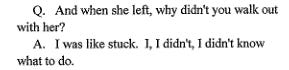
When Epstein was done, he walked into the sauna. She went into the office to wait for E.W, where she retrieved her two hundred dollars from his robe on the way out.
They walked to City Place, caught a bus and left.
She never went back.
Why She Didn’t Tell Anyone
This is the question people always ask. Why didn’t she report it. Why didn’t she tell her parents. Why didn’t she go to the police.
She answered it under oath. In her own words, with no coaching, while sitting across from a doctor hired by Epstein’s defense team, at only nine teen years old.
“What’s to tell? I mean, I feel more, like, low and lousy that I would even consider to go over to somebody’s house like that. Why would I tell somebody, so then they think of me low.”
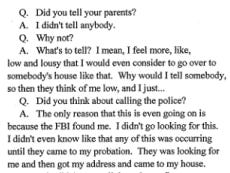
The shame. The calculation that no one would believe her, or worse, that they would think less of her for going. This page is the reason survivors don’t report.
— EFTA00723713
She was thirteen years old, and she had already internalized the shame that this man had engineered for her. She didn’t even know the street she had been taken to. She remembered seeing his first name on a nameplate on the desk and she didn’t know his last name until years later, when the FBI came to her probation officer’s office looking for her.
She didn’t go looking for justice. Justice found her, sort of, in the way it always seems to find these women — incomplete, delayed, dressed up as a forensic evaluation on behalf of the man who hurt her.
She joined the civil lawsuit because, as she put it:
“It’s not fair. It’s not fair that he like does this to people, like to little girls. Kids shouldn’t have to go through stuff like that. They are young and innocent.”
She said that at nineteen, sitting in a room full of strangers, on behalf of a defense doctor, while her babysitter waited at home and her 22 month old son was asking for her.
She said it crying, then she asked to go home.
