
Epstein's Other Island: Zorro Ranch
Part One: Every Other Property Got Raided. This One Didn't.

This is the first part of the 49 Zorro Ranch Road Series
| Victim Standalone | Part Two | Part Three | Part Four
Your subscription truly helps share this work.
If you have tips related to the Zorro Ranch and Epstein Investigation, contact:
https://nmdoj.gov/get-help/epstein-zorro-tips/
49 Zorro Ranch Road
There is an address in the federal record that appears hundreds of times across millions of pages of documents. It shows up on Deutsche Bank account filings, on Limited Power of Attorney forms, on punch lists and grocery runs, on shell company registrations, and on the email signatures of the people who ran the operation day to day. The address is 49 Zorro Ranch Road, Stanley, New Mexico. It belonged to Jeffrey Epstein for nearly thirty years. In that time, it was never searched by federal agents.
Not once.
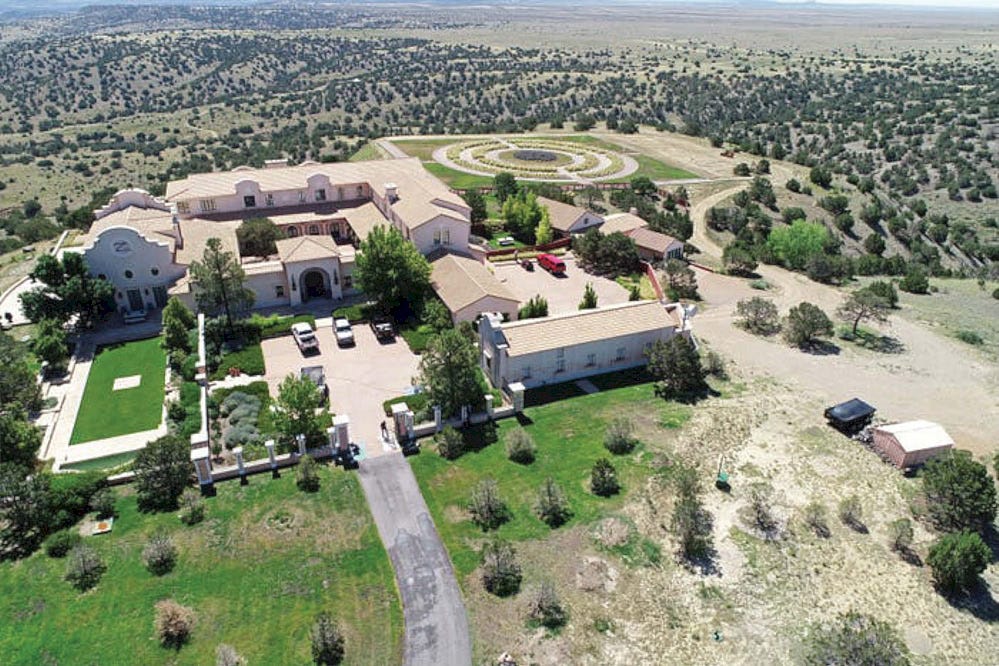
Zorro Ranch aerial. Source: Wikimedia Commons

When Epstein was arrested in July 2019 on federal sex trafficking charges and the FBI moved on his properties — raiding his Manhattan mansion, securing evidence from Little St. James Island — the New Mexico ranch was left alone. A December 2019 email released in the Epstein Files, sent from federal authorities to the executors of Epstein's estate, confirmed it plainly: agents had “not searched the New Mexico property.” New Mexico's own investigation, opened by then-Attorney General Hector Balderas, was shut down at the direct request of the U.S. Attorney's Office for the Southern District of New York. The feds told the state to stand down. So the state stood down.
That was 2019. The ranch sat undisturbed for years while construction began under new ownership. It wasn't until March 9, 2026 — nearly seven years after Epstein's death — that New Mexico state investigators, K-9 units, and state police finally set foot on the property in any official capacity. Seven years. Whatever was there when Epstein died, it had seven years to disappear.
“Revelations outlined in the previously sealed FBI files warrant further examination.” — New Mexico Department of Justice, February 19, 2026
This series is about what the documents actually show. Not speculation. Not theory. What the Epstein Files — the same records the federal government spent years keeping sealed — reveal about 49 Zorro Ranch Road: who built it, who ran it, who banked it, who visited it, and who made sure nobody looked too hard at any of it for a very long time.
We start with the paper trail, like alqays — and it is longer and more twisted than many would think
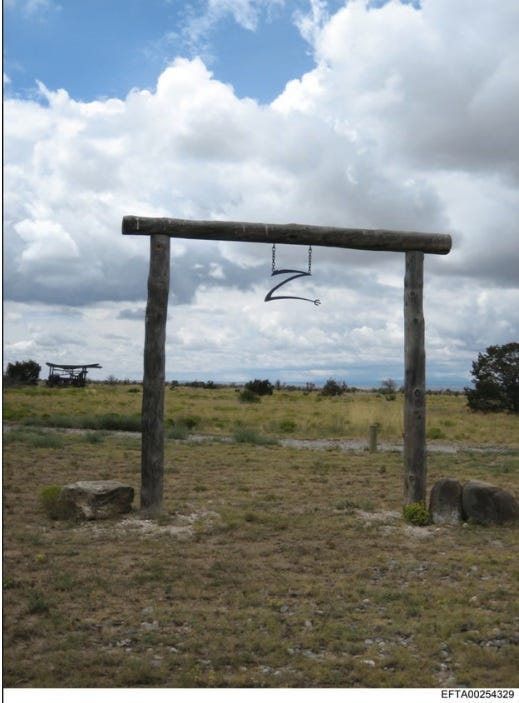
Zorro Ranch sign. Source: DOJ Epstein Library EFTA00254329
How the Ranch Stayed Hidden in Plain Sight
Epstein didn't own Zorro Ranch the way most people own property. He controlled it through a web of corporate entities that shifted names and structures over the years, each layer adding distance between the man and the address.
The property was originally purchased in 1993 through a shell company called Zorro Trust. That entity later became Cypress, Inc. — the same company name attached to state grazing leases that gave Epstein control of an additional 1,159 acres of public land surrounding the ranch. He paid $87,222 a year for those leases. He did not use the land for agriculture, which was the only legal basis for holding them. State officials would later say they had “virtually no access and little knowledge” about what was happening on land they were renting to him.
DOCUMENTED: By the time of Deutsche Bank's 2014 due diligence review — documents now part of the public Epstein Files — the corporate structure had expanded. The bank's research showed two primary entities tied to the address: Zorro Development Corp, registered as a Foreign Profit Corporation, and Zorro Ranch LLC, incorporated in New Mexico on December 27, 2002, and listed as an Exempt Domestic Limited Liability Company. Both shared the same address: 49 Zorro Ranch Road, Stanley, NM 87056.
The executive list on those records reads like a shorthand for Epstein's inner circle. Jeffrey Epstein is listed as Owner, President, Treasurer, and Director. Darren Indyke — Epstein's longtime attorney and financial fixer, who has since appeared in his own right across the Epstein Files — is listed as Secretary. Janice Ahern is listed as President across multiple filings. The property's registered agents included Prentice-Hall Corporation System, a standard incorporation service, and Janice M. Ahern directly.
There is also a third corporate layer that surfaces in the banking records. In March 2017 — two years before Epstein's arrest, one year before his last known stay at the ranch — Epstein personally called Deutsche Bank relationship manager Stew Oldfield to open a new account under Zorro Management LLC and add two new signatories. The primary contact for that account was Darren Indyke. The account appears in Deutsche Bank's internal daily deposit reports alongside Epstein's full network of entities: Gratitude America Ltd., The Haze Trust, Southern Trust Company, Neptune LLC, NES LLC, and others. Zorro Management LLC carried balances ranging from $196,000 to $482,000 in 2017 alone.
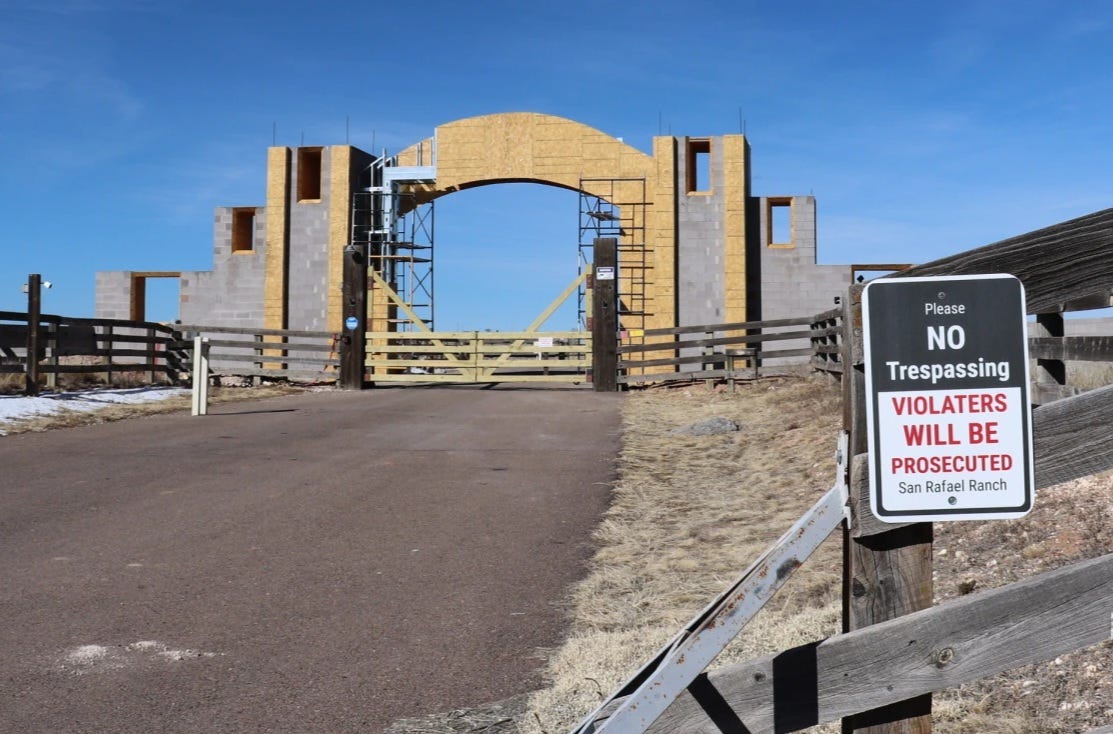
The gated entrance to San Rafael Ranch in New Mexico — isolated, secured, and largely hidden from public view. Source: Savannah Oeters.
The address appears hundreds of times in federal records. It was never searched by the FBI.
The New Zealanders at the Center of the Operation
For most of Epstein's tenure at Zorro Ranch, the property was managed by a New Zealand couple: Karen and Brice Gordon. They show up throughout the Epstein Files under the email signature “Zorro Management LLC, 49 Zorro Ranch Rd, Stanley, NM, Ranch Manager.” Across hundreds of documents, they are the operational heartbeat of the property — scheduling guests, managing contractors, coordinating punch lists, running grocery logistics, handling vehicle titles, and corresponding directly with Epstein, Lesley Groff, Darren Indyke, and Karyna Shuliak.
Karen Gordon's name appears explicitly in an email from Lesley Groff asking her to call Epstein. It appears in emails to and from Jeffrey Epstein directly — one, dated October 1, 2012, shows Epstein replying to Karen about guests arriving on Little St. James Island, asking whether they would stay for lunch or dinner. She is simultaneously identified in the files as Island Manager at LSJ LLC, 6100 Red Hook Quarters, St. Thomas, USVI. The Gordons weren't managing just the ranch. They were managing multiple properties across Epstein's network.
DOCUMENTED: Brice Gordon's footprint in the files is equally extensive. A 2006 notarized document lists him as Manager of Zorro Trust — the shell company that originally held the property. He appears in HVAC service agreements, internet connectivity proposals, landscape and garden correspondence, and financial records. He communicated directly with Epstein by email and phone. He coordinated with Lesley Groff on scheduling. He is listed as a point of contact on security and infrastructure proposals for the ranch going back years.
The FBI interviewed Brice Gordon at Zorro Ranch in August 2007. What he told them — and what investigators did with that information — is only partially visible in the released files. According to reporting based on those records, Gordon told the FBI that Epstein flew in guests and “masseuses” to the ranch, and that massage therapists were hired locally through Ten Thousand Waves, a well-known spa in Santa Fe, or through referrals. Ten Thousand Waves has publicly denied providing or referring masseuses to Zorro Ranch.
Here is what makes this significant: the FBI interview notes from that 2007 conversation are missing from the publicly released Epstein Files. The document exists — there is a record that the interview occurred — but the notes themselves are not included in what the Department of Justice released. That is a gap worth noting. A ranch manager who managed the property through the entire period of alleged abuse, who was interviewed by federal agents in 2007, whose interview notes were not made public. The New Mexico Truth Commission has named the Gordons as “people of interest.” New Mexico State Representative Andrea Romero has called their continued absence from public view “larming.”
ALLEGATION: What the Gordons knew, what they saw, and what they may have participated in or facilitated — willingly or otherwise — remains one of the central unanswered questions surrounding the ranch. They have not spoken publicly. Their current whereabouts are not confirmed in open reporting.
What is confirmed, in the documents, is this: Brice Gordon was named as a beneficiary in Epstein's trust, designated to receive two million dollars upon Epstein's death. His PayPal account was examined by the FBI in August 2019 as part of the post-arrest investigation. He was a non-testifying witness in materials related to the United States v. Ghislaine Maxwell prosecution. No charges have been filed against either Karen or Brice Gordon.
Zorro Ranch Was the Base. Silicon Valley Was the Destination.
On August 2, 2015, Jeffrey Epstein departed Zorro Ranch for San Francisco. His calendar — now part of the public Epstein Files — shows his itinerary in detail. He flew from Zorro to San Jose, checked into the Rosewood Sand Hill in Menlo Park, and spent the afternoon with Peter Thiel in Palo Alto. That evening, at Baume Restaurant on California Avenue, he met with Mark Zuckerberg, Joi Ito, Reid Hoffman, and others.
The next day, August 3, he returned to Burbank, went to see a plane for sale in Los Angeles — taking Joi Ito with him — and then flew back. Destination: Zorro.
Zorro Ranch was his base of operations for that Silicon Valley circuit. Not a hotel. Not a rented house. The ranch. He left from there, conducted his meetings with some of the most influential figures in technology and venture capital, and returned there. This is documented. It is in the calendar.
He was also at Zorro Ranch for the rest of that August — the itinerary shows him there continuously through the month, with visitors arriving by JetBlue into Albuquerque. A recurring arrival: 10:58pm via JetBlue #665. Different reservation codes, same flight, multiple consecutive weeks. Someone was making that trip regularly.
DOCUMENTED: This matters not because of what it proves about the Silicon Valley meetings — those figures have their own stories, to be addressed in a later investigation — but because of what it shows about the ranch itself. Zorro was not a hideaway he retreated to and isolated himself in. It was a hub. A property he operated out of, entertained from, returned to. The paper trail in the Epstein Files reflects that. Dozens of emails, itineraries, punch lists, and financial records all flow through that one address.
New Mexico Asked, New York Said No
On July 6, 2019, federal agents arrested Jeffrey Epstein at Teterboro Airport. Over the following weeks, the FBI executed search warrants on his Manhattan mansion and on Little St. James Island. His New York home was raided. His island was secured. Evidence was seized from both.
No warrant was ever issued for Zorro Ranch.
This was not an oversight. The decision — or the failure — was deliberate enough to be documented. A December 2019 email included in the Epstein Files, sent from federal prosecutors to the executors of Epstein's estate, confirmed in writing that agents had not searched the New Mexico property. New Mexico's own attorney general opened a parallel investigation. Federal prosecutors in New York told him to close it, citing concerns about a “parallel investigation.” He closed it. The ranch remained unsearched.
Epstein died in his cell on August 10, 2019. His death was ruled a suicide, though the circumstances have been disputed by independent forensic analysis and by his own family. The federal investigation was effectively concluded without ever examining one of his primary properties.
What was at Zorro Ranch in August 2019? We do not know. What evidence existed there? We do not know. What happened to it in the years between Epstein's death and the first state search in March 2026? We do not know. Seven years is a very long time.
The state closed its investigation in 2019 at the request of federal prosecutors in New York. The ranch sat unsearched for nearly seven years.
In February 2026, New Mexico Attorney General Raúl Torrez announced the criminal investigation into Zorro Ranch had been reopened. He cited “revelations outlined in the previously sealed FBI files” as justification. On March 9, 2026, state police and a K-9 unit from Sandoval County Fire and Rescue entered the property for the first time under any law enforcement authority. The search is ongoing. No results have been publicly disclosed.
Construction on the property — which the new owner, Texas businessman Don Huffines, had begun in connection with plans to turn the ranch into a Christian retreat — was ordered to stop by Santa Fe County officials due to lack of permits. A former FBI agent serving on the Truth Commission was among those who raised concerns that evidence could be compromised by ongoing renovation work.
The ranch has been renamed, it is now called Rancho de San Rafael, after the patron saint of healing. Whether there is anything left to heal is the question the Truth Commission is now tasked with answering.
Following the Trail
This is Part One of four. The paper trail for 49 Zorro Ranch Road does not end with the corporate structure or the managers or the missing FBI warrant. It extends into the political donations that kept the ranch shielded, the guests whose names appear in the documents, the victims whose testimony was documented and then ignored, and the financial network that processed money through that address for decades.
Part Two covers the people — who visited, who donated, who knew.
Part Three covers the major failure — the deliberate, documented institutional breakdown that allowed this to continue.
Part Four covers what remains — what the search found, what the Truth Commission is pursuing, and what the evidence trail says about whether the operation at that address ever truly ended.
The address is still there; the land and its ghosts. The questions are all still very much alive.
Here we follow the paper trail all the way to the end.
Last Page First is an independent investigative publication. Paid subscribers make the deep dives possible—FOIA templates, citation indexes, Document Room access, and subscriber discussion threads. If this piece reached you, share it. If you want to help keep it going, subscribe.
If you have documents, names, or anything relevant to an investigation, my inbox is open to everyone. Reply to this email or contact the publication. Your name stays private unless you tell me otherwise.
Sources
Epstein Files, EFTA00285038, EFTA00285034, EFTA00344593 — August 2015 itineraries (Zorro/Silicon Valley)
Epstein Files, EFTA01345194, EFTA01345302, EFTA01382237, EFTA01416707 — Deutsche Bank KYC/account records, Zorro Management LLC
Epstein Files, EFTA02089629 — Lesley Groff email to Karen Gordon
Epstein Files, EFTA01891133 — Karen Gordon as LSJ Island Manager, direct email with Epstein
Epstein Files, EFTA00430016, EFTA02185230 — Limited Power of Attorney, Brice Gordon as Zorro Trust Manager
New Mexico Department of Justice statement, February 19, 2026
New Mexico Department of Justice statement re: search, March 9, 2026
NBC News: 'How Epstein lured girls to his Zorro Ranch,' March 2026
NZ Herald: 'New Mexico lawmakers may subpoena Brice and Karen Gordon,' February 2026
Newsweek: 'Zorro Ranch Update: Evidence Fears,' February 2026
Time: 'Epstein's Zorro Ranch Searched in Criminal Investigation,' March 2026
Santa Fe New Mexican: 'Owners of former Zorro Ranch ordered to stop construction,' February 2026
AP News: 'Jeffrey Epstein's New Mexico ranch linked to investigation,' July 2019
Awesome work. Thanks for your dedication !
The federal government shut down the investigation! I imagine they shut down the Palm Beach investigation as well.