
JP Morgan and the Epstein Money Trail
JP Morgan processed $1.08 billion in Epstein transactions. Their top banker managed the account. And when the FBI finally came, the cameras were already gone.

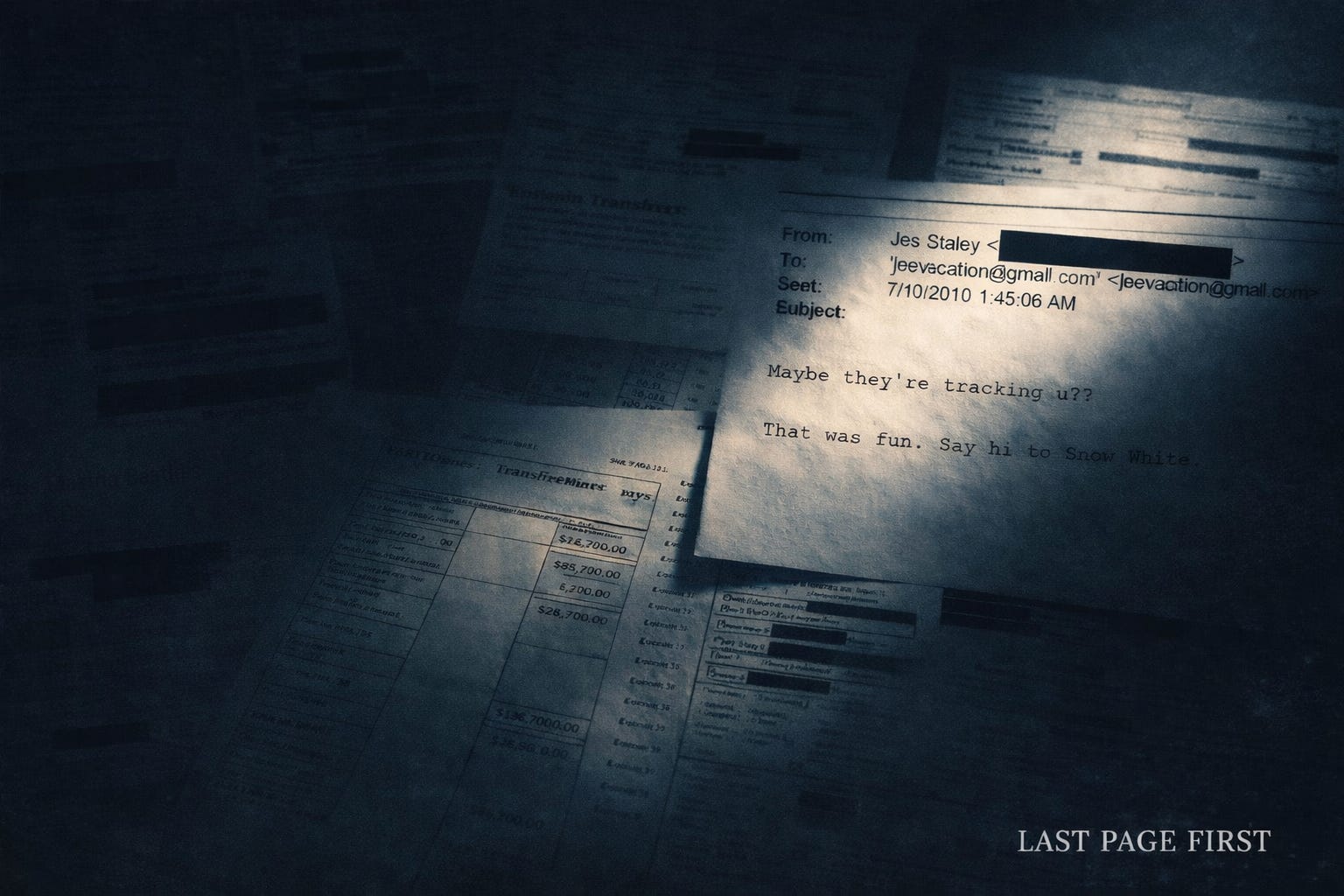
The FBI internal documents released under the Epstein Files Transparency Act tell a story. Not just about Jeffrey Epstein. About the infrastructure around him. The systems that held him up, processed his money, moved his girls, and kept his name clean long enough for him to die in a federal prison with the evidence still missing.
JP Morgan Chase is that infrastructure.
The $1.08 Billion Paper Trail
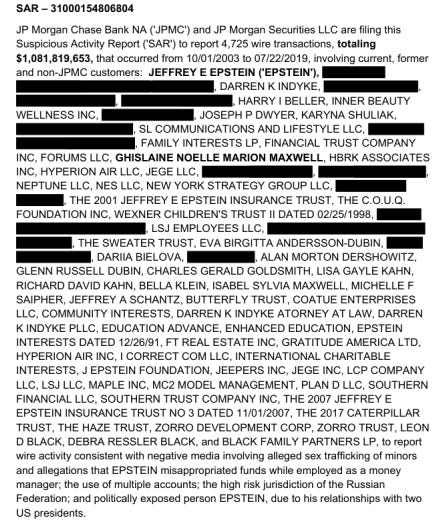
$1,081,819,653.
That is the figure in the Suspicious Activity Report filed by JP Morgan Chase and included in the FBI documents. Over 4,700 wire transactions. Spanning 2003 to 2019. The year Epstein died in federal custody.
JP Morgan kept Jeffrey Epstein as a client from 1998 to 2013. Fifteen years. Through his 2005 Palm Beach investigation. Through his 2008 Florida conviction. Through the headlines, the victims, the grand jury subpoenas. They kept him.
The SAR did not flag Epstein the first time he came up in an internal risk review. That review happened in 2006. JP Morgan employees found newspaper articles about Epstein being investigated for paying cash to have underage girls brought to his home. They noted it. They flagged him as high-risk. And then they retained him as a client.
They kept the account open for seven more years.
The Banker Who Kept the Account
His name is Jes Staley. And for the entirety of JP Morgan’s relationship with Jeffrey Epstein, he was the account executive. The man who vouched for him. The man who managed him. The man who kept the money flowing.
Staley was not some low-level associate who got played by a slick predator. He was the head of JP Morgan’s Private Bank, the division dedicated to ultra-wealthy clients. Managing Epstein was his job. And by every indication available in the court record, it was something he took personally.
The U.S. Virgin Islands lawsuit against JP Morgan uncovered over 1,200 emails between Staley and Epstein sent from Staley’s official JP Morgan email account. Between 2008 and 2012. While Epstein was a convicted sex offender serving his sentence.
The emails are worse than you think.
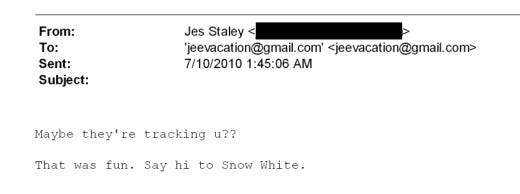
Department of Justice Email from Jes Staley to Jeffrey Epstein EFTA02410216
In July 2010, Staley wrote to Epstein: “That was fun. Say hi to Snow White.” Epstein replied: “What character would you like next?” Staley answered: “Beauty and the Beast.” Epstein: “Well, one side is available.”
Lawyers for the Virgin Islands argued these were references to young women Epstein was procuring for Staley. JP Morgan’s position was that it was not clear the references concerned minors or women under coercion. That is the defense. That is the best they had.
In November 2009, Staley wrote to Epstein from a hot tub at Epstein’s Little Saint James island: “I owe you much. And I deeply appreciate our friendship. I have few so profound.”
In December 2009, from New York City: “I realize the danger in sending this email. But it was great to be able, today, to give you, in New York City, a long heartfelt hug.”
The government of the U.S. Virgin Islands alleged in its lawsuit that Staley had personally observed Epstein abusing a victim. Staley denies this. He has never been criminally charged.
JP Morgan’s official position is that Staley is a rogue employee. That whatever happened with Epstein is Staley’s responsibility. That the bank bears no liability.
They paid $290 million to settle with victims.
They paid $75 million to the U.S. Virgin Islands.
That’s $365 million from a bank that claims it didn’t know what was happening.
What JP Morgan Knew
The bank did not walk into this blind. The court record makes that plain.
2006: JP Morgan compliance flags Epstein as high-risk. Notes the Florida indictment. Retains him anyway.
2008: Epstein pleads guilty to procuring a minor for prostitution. Serves thirteen months in a Florida county jail. JP Morgan keeps the account open.
One internal email from 2008 estimated Epstein’s assets as a probable outflow. The bank still did not close the account. Staley was the reason. He had vouched for Epstein. And for years, whoever reviewed the question of whether to keep Epstein deferred to Staley’s judgment.
JP Morgan assigned Staley to manage Epstein specifically because of Epstein’s wealth, his connections, and his ability to refer other ultra-wealthy clients. They were profiting from his network. They knew what his network was.
At least twenty victims received payments totaling more than $1 million collectively through JP Morgan accounts between 2003 and 2013. That is not a rogue employee. That is a pipeline. Epstein also withdrew more than $775,000 in cash from his JP Morgan accounts during that period. Cash he was known to use to pay for sexual encounters. The transactions should have been flagged under federal anti-money-laundering law. They were not.
JP Morgan also wired nearly $1.5 million from Epstein’s accounts to known recruiters, including to Jean Luc Brunel’s modeling agency MC2, the operation used to identify and bring in young women. The bank processed that money. They saw where it was going.
A lawyer for the Virgin Islands said it plainly in court: they broke every rule to facilitate his sex trafficking in exchange for Epstein’s wealth, connections, and referrals.
The Allegations in the FBI Documents
Suspicious Activity Report – JP Morgan EFTA01648787
The FBI documents include a spreadsheet compiled internally in July 2025. Agents were asked to pull together victim allegations against a list of prominent names. The list includes Donald Trump, Harvey Weinstein, Prince Andrew, Glen Dubin, Jes Staley, Leon Black, Les Wexner, Alan Dershowitz, Bill Clinton, Tony Blair, Howard Lutnick, Jean Luc Brunel, and William Barr.
These are allegations. Victim accounts. They are one-to-two sentence summaries of what victims stated to investigators. Some are detailed. Some are corroborated by other witnesses. Some are not. The FBI itself has said no criminal charges are forthcoming based on these files and that no client list was found in the evidentiary sense. That is the official conclusion.
What the documents show is who was in the room and what victims said happened.
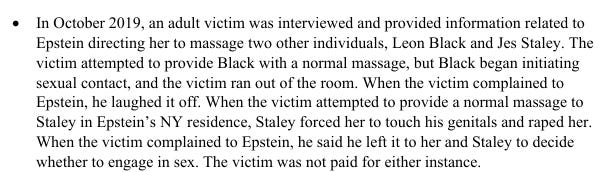
Jes Staley: A victim stated that Epstein told her to give Staley a massage at his mansion. According to her account, Staley forced her hands onto his crotch and had rough sex with her.
Leon Black: Multiple victim accounts. One victim stated she performed oral sex on Black. Another stated Black raped her numerous times, sex trafficked her including at Epstein’s properties, and threatened to destroy her life. Black has denied wrongdoing. The FBI noted multiple victim statements.
Howard Lutnick: Simon Andriesz reportedly told investigators that Lutnick made money through Ponzi schemes and money laundering. Lutnick and Epstein were neighbors. Epstein reportedly sold Lutnick a home for $10. It was later sold for millions. Lutnick is currently the U.S. Secretary of Commerce.
The FBI documents are what the FBI compiled. They reflect what victims told investigators, flagged alongside the names of powerful men. The men on that list deny wrongdoing. Most have not been charged. The documents exist regardless.
Document Excerpt – FBI Files EFTA01649143
The Evidence That Disappeared
Here is what happened in 2005 when Palm Beach police executed a search warrant on Epstein’s mansion.
The surveillance cameras were still mounted on the walls. But the wires were hanging. Disconnected. The recording equipment was gone.
The computers were gone. Every location where a computer had been present showed monitors, printers, peripheral devices. The CPUs had been removed. File folders had their contents taken out. The Palm Beach detective who executed the warrant noted all of this in a court filing.
An FBI agent later attested in a sealed filing that the items were purposely removed from Epstein’s home in anticipation of the search warrant execution.
Before the warrant. Someone knew it was coming.
Palm Beach Police Chief Michael Reiter said publicly that Epstein’s defense team appeared to know details of the investigation before they were made public. Details that were not public. Details from the probable cause affidavit. His assessment was that someone at the state attorney’s office had leaked case information to Epstein’s lawyers.
This happened again in 2019.
The FBI executed a search warrant on Epstein’s Manhattan townhouse on July 6, 2019. Agents found the safe. Inside the safe: $70,000 in cash, 48 loose diamonds, jewelry, an Austrian passport with Epstein’s photograph under the name Marius Robert Fortelni, and hard drives. The agents did not have a warrant broad enough to seize the electronics. So they photographed them and left. When they returned with the correct warrant, the hard drives and CDs were gone from the safe.
Agent Kelly Maguire called Richard Kahn, one of Epstein’s attorneys. He arrived minutes later carrying two suitcases with the items. He had them. Epstein was in custody. Someone had accessed the safe and moved the evidence in between the two warrant executions.
And the federal documents released in 2025 and 2026 confirmed that prosecutors claimed they found no surveillance cameras in Epstein’s bedroom or massage rooms at the townhouse. Only entrance cameras. Only thirty days of retained footage.
But documents from elsewhere in the Epstein files tell a different story. In 2014, Epstein instructed an employee to purchase three motion-detecting hidden cameras. The employee told him two had already been bought and were being installed inside Kleenex boxes. By 2019, sources indicate at least three cameras were mounted in or near Epstein’s bedroom in New York. A room on the ground floor was reportedly marked with a sign reading ‘24 Hour Video Surveillance.’
Either the cameras were removed before the FBI arrived. Or federal prosecutors are not telling the full story about what they found. One of those two things is true.
There is a pattern here. Every time law enforcement got close, the evidence was already in motion. The computers, the hard drives, the recordings. Somebody was always a step ahead.
The SAR Names
The JP Morgan Suspicious Activity Report names more than just Epstein. It names Ghislaine Maxwell. It names Jes Staley’s in-laws, Eva Birgitta Andersson-Dubin and Glen Russell Dubin. It names Alan Dershowitz. It names Leon D. Black and his wife Debra Ressler Black and their family investment vehicle. It names Les Wexner’s charitable trust. It names Richard David Kahn and Lisa Gayle Kahn.
Richard Kahn is the man who showed up with the suitcases. He is listed as both a name in the SAR and as an executor of Epstein’s estate.
The SAR flagged the account for sex trafficking allegations, misappropriation of funds, multiple accounts, transactions through Russian Federation jurisdiction, and relationships with two U.S. presidents.
Two presidents. In a Suspicious Activity Report. Filed by the largest bank in the United States.
A second SAR in the documents flagged nearly $18 million in transfers made between November 2019 and July 2020, describing them as suspicious transfers used to conceal the origin of funds, to purchase property, and to fund legal defense fees for a person indicted for sex trafficking. The transfers were described as possibly connected to human trafficking and as routed through accounts to conceal their connection to Ghislaine.
Maxwell was arrested on July 2, 2020. The transfers appear to have continued almost until the day she was taken into custody.
A third SAR, filed by UBS, documented Maxwell allegedly hiding assets through UBS accounts, issuing wires to accounts controlled by Scott Borgerson, believed to be her secret husband. Twenty-nine payments. $18.2 million. December 2014 through July 2020.
What They Called the End
On July 7, 2025, the DOJ and FBI issued an official memo. No client list. No blackmail evidence. Suicide. No further disclosure warranted.
An FBI agent’s email from around the same time stated “I’m hoping this is the beginning of the end.”
The memo came out while Trump was publicly accusing Obama of treason. While the House Speaker shut down floor votes to prevent additional Epstein file releases. While a judge was weighing whether to unseal Maxwell’s grand jury records.
The DOJ memo argued that further disclosure would expose innocent people to allegations of wrongdoing. The documents released in the months that followed showed what they were talking about. The derogatory spreadsheet. The victim statements. The names.
The FBI found no cameras. Found no blackmail tapes. Found no client list in the formal evidentiary sense. The official conclusion is that Epstein operated largely alone, with Maxwell, and that no charging decisions are forthcoming.
What they cannot explain away is the money. The $1.08 billion. The $365 million in settlements. The two suitcases. The wires hanging from the walls in Palm Beach. The hard drives that were gone and then were not gone and then were handed over by an attorney who had them in luggage.
You do not need a client list to understand what happened. The SAR is the client list. The emails are the relationship. The settlements are the acknowledgment.
JP Morgan processed the money. Jes Staley managed the account. The bank kept him for fifteen years. Twenty victims received payments through those accounts. And when the government finally came for Epstein, the cameras were already disconnected and the computers were already somewhere else.
The pattern isn’t subtle.
The system didn’t fail.
It worked exactly as designed.
And the people it protected were never the victims.
Sources: FBI internal documents released under the Epstein Files Transparency Act (EFTAs 01648786–01649227), U.S. Virgin Islands v. JPMorgan Chase Bank (22-cv-10904), Jane Doe 1 v. JPMorgan Chase Bank (22-cv-10019), JP Morgan SAR 31000154806804, NBC News, CNBC, CNN, ABC News, CBS News.
Last Page First is an independent investigative publication. Paid subscribers make the deep dives possible—FOIA templates, citation indexes, Document Room access, and subscriber discussion threads. If this piece reached you, share it. If you want to help keep it going, subscribe.
If you have documents, names, or anything relevant to an investigation, my inbox is open to everyone. Contact us here. Your name stays private unless you tell me otherwise.