
375 Mill Creek and Wexner's Dybbuk
Les Wexner named the "thing inside him" - the thing he was possessed by. Then, he handed Jeffrey Epstein the keys to his life.

Before we get to the chalet, we need to talk about a certain word… for most people who have encountered it in the context of Leslie Wexner and Jeffrey Epstein have no idea what it actually means…
Dybbuk
The word dybbuk comes from the Hebrew dabaq — it means to cling, to adhere, to attach. In Kabbalistic tradition, a dybbuk is not a demon — it is something more specific. It is the soul of a deceased person whose sins were so grievous, so evil, that even Gehenna — the Jewish purgatory — would not take them in. Turned away from the afterlife itself, and unable to rest, the lost soul wanders — hunts for a host body to inhabit. It will eventually find one, enter and hold on for dear life.
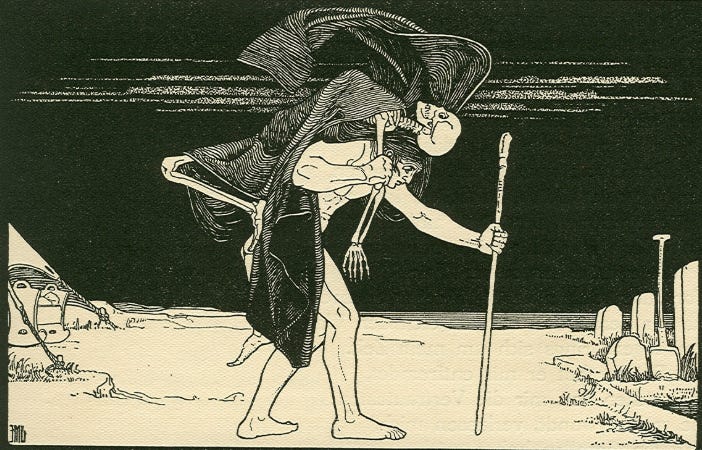
Dybbuk — by Ephraim Moshe Lilien (1874–1925)
The first recorded case of dybbuk possession appeared in Safed — Northern Galilee —in 1571. The concept was formalized by the Kabbalist Isaac Luria, whose doctrine of gilgul, the transmigration of souls, provided the theological architecture for what such a spirit was and why it clung. Luria taught that sins of sufficient weight placed the soul outside the ordinary machine of death and judgment — not demonic — not Satanic, something even more haunting: a human soul, so corrupted past the point of admission to Gehenna, that it resorts to attaching itself to the living because it has nowhere else to go.
Exorcism rituals require a rabbi, 10 Jewish men, 7 Torah scrolls removed from the ark, 7 black candles and 7 blasts of the shofar.
Belief in dybbuks spread through Eastern European Jewish communities in the sixteenth and seventeenth centuries. Shloyme Zanvl Rappoport’s(also known by his pen name S. Ansky) 1914 Yiddish play ‘The Dybbuk’ brought it into secular culture — it is about a young bride possessed on the eve of her wedding by a soul that would not release her. Leonard Bernstein later composed a ballet from it, and the dybbuk became shorthand in the secular Jewish imagination for a particular kind of inner force — the thing that will not be still, the thing that drives, haunts, clings and will not let go. Educated American Jews of the twentieth century used the word the way Wexner used it — as a poet’s vocabulary for compulsion. The word carries its full kabbalistic weight underneath whatever secular usage you spin on it. The tradition it comes from is precise about what a dybbuk is: a soul too corrupted for heaven and too restless for hell, looking for somewhere to put itself.
That weight of that meaning does not disappear because a billionaire uses it metaphorically.
What Wexner Exactly Said
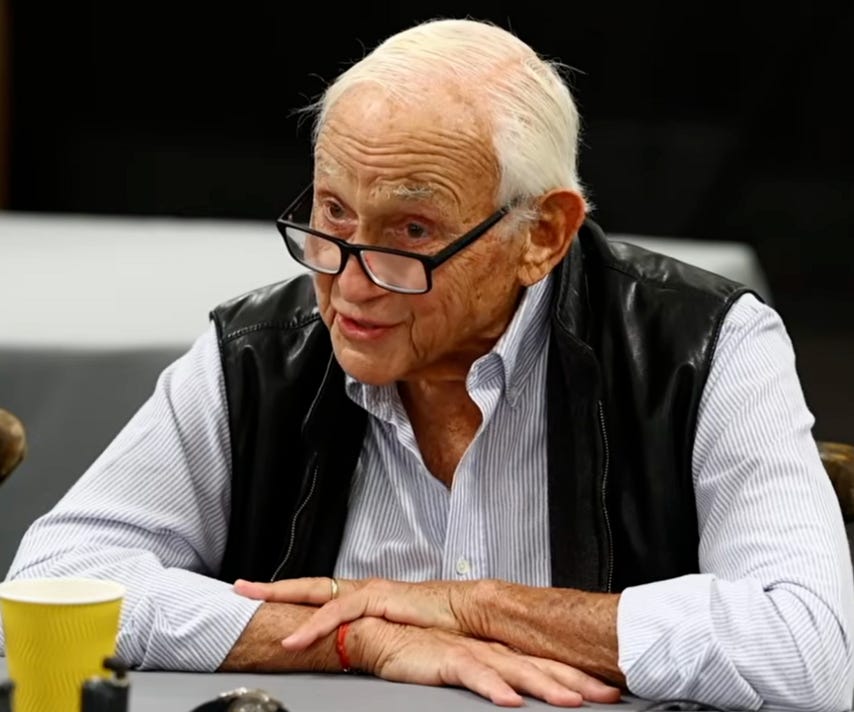
Still frame taken from the Deposition of Leslie Herbert Wexner by the House Oversight Committee on Feb. 18, 2026
In August 1985, journalist Julie Baumgold profiled Leslie Wexner for New York Magazine. The piece was called “The Bachelor Billionaire: On Pins and Needles with Leslie Wexner.” Wexner was 48 years old, one of the wealthiest men in America, founder of The Limited, and newly on the Forbes 400. Leslie was, by his own account, a man haunted by something he could only name with that specific word.
He called it his dybbuk. He said it had been with him since his childhood and it made him feel ‘molten.’ It gave him ‘shpilkes’ - the Yiddish word for pins and needles — for the itch of a man who cannot sit still — who is always being driven toward the next thing and the thing after that.
He described his dybbuk as the source of his ambition and his torment. The engine of his success and the thing that made success feel hollow the moment it arrived to him.
In 1977, Wexner was 40 old. He nearly froze to death climbing alone on a mountain near his home in Vail, Colorado. The temperatures dropped drastically but he made it back home. Afterward, he told Baumgold, his dybbuk returned to him with a force he had not felt in years — he ‘decided to change his life.’
Baumgold wove the dybbuk through the entire profile as the organizing principle of her portrait. A billionaire with a poet’s vocabulary for his own compulsion. A man who described himself as inhabited. As driven by something that would not let him rest.
That is the 1985 record. Wexner used the word, and he used it about Vail. He used it to describe the force that ran his life- in his own words, to a journalist, in print.
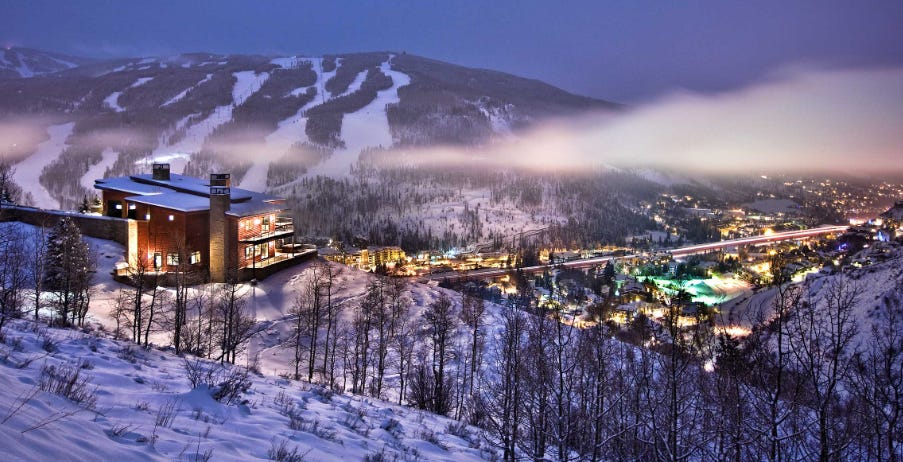
Vail, Colorado
Whitney Webb Connection
In June 2022 investigative journalist Whitney Webb published a piece called “Leslie Wexner’s Inner Demon” on her Unlimited Hangout platform, later excerpted in her book — One Nation Under Blackmail. Webb read the Baumgold profile closely and asked a question Baumgold did not ask: what does it mean that a man, who would later become Jeffrey Epstein’s primary patron and financial architect, was inhabited by a clinging soul too corrupt for Gehenna?
Webb did not treat the dybbuk as casual metaphor. She placed Wexner’s use of the word inside the full kabbalistic context of what that word actually describes and held it there, respectfully. Her piece circulated widely — David Icke reposted it to his website, it was shared on Sons of Liberty Media, and archived across platforms. People who had never read the 1985 New York Magazine profile encountered Webb’s reading of it as their introduction to the story.
What you make of the dybbuk story is up to you — but, what the federal records shows us is: Wexner chose that word specifically. He returned to it — he used it to describe the animating force of his life — the thing inside him that clung, sat at the helm, and would not let go. Leslie said it came back to him on a ‘mountain in Vail’. Now whether that is just a rich man’s self mythology or something Wexner understood about himself on a deeper level, more literal — the documentary record does not resolve. It sits there, and makes us speculate, fill the gaps in ourselves.
375 Mill Creek Circle
375 Mill Creek Circle sits at the base of Vail Mountain, ski in ski out — directly behind the Golden Peak base area — with views of the Gore Range. 7 ensuite bedrooms, 9 bathrooms it sits 7,738 square feet. Made with Koa wood harvested from Hawaii and hand carved by a craftsman named Rudi Neumayr. 4 season pool, a sauna, even a dumbwaiter. A master suite with a large 4 poster bed, described by the Sotheby’s listing as: fit for a ‘Scandinavian King.’
The children’s bedrooms in the property had large, oversized twin bunk beds and what the listing called a ‘magical world of secret cubby holes.’
The estate sleeps 18 total.
Epstein did not purchase it himself — in August 1998 — Elizabeth Ross “Libet” Johnson, a Johnson & Johnson heiress whose finances Epstein managed, transferred the deed into a trust she shared with Epstein as co-trustee. He was installed into the property by a woman whose money he controlled.
There is a pattern documented here. Wexner owned the Herbert N Straus House — the largest single family residence in Manhattan. He put it into a trust and then named Epstein a trustee. JE eventually came to own it outright.
The same sequence with the Vail chalet: a trust, a wealthy client, a co-trusteeship that became possession. Epstein did not buy properties himself — he was placed inside them by people who trusted him with everything.
The chalet sold for $24 million in July 2020, a year after Epstein died in federal custody. One of Johnson’s children signed as trustee at closing. Where the proceeds went is publicly unresolved and whether Epstein’s estate had a claim to any portion has never been established. Local law enforcement told the Vail Daily they were never contacted by federal investigators about the property.
Nobody officially asked what happened there and nobody officially asked who visited, or how often, or why a family ski house needed to sleep 18.
On The Record
Wexner owned a home in Vail in the 1980s, the Baumgold profile confirms it, the Vail Daily confirmed it. Both men had Colorado mountain properties and both men had a relationship so close that Wexner gave Epstein power of attorney over his finances in 1991 and employed him as his financial manager for two entire decades. Executives at L Brands reported in the mid 1990s that Epstein was using his Wexner connection to pose as a Victoria’s Secret recruiter.
Then, there is Maria Farmer
In the summer of 1996, Epstein directed Farmer — a young artist he had hired — to work as an ‘artist in residence’ at a guesthouse in New Albany, Ohio. The property had been deeded to Epstein by Wexner in 1992. It sat on or near the Wexner estate and was guarded by Wexner’s security team, including sheriff’s deputies Wexner had contracted to guard it. Farmer has stated in sworn affidavits that Epstein and Ghislaine Maxwell sexually assaulted her there during that summer, that she called for help and was told by security staff she could not leave. She claims she was held against her will for 12 hours until her father drove from Kentucky to get her. She reported the assault to the NYPD and the FBI — authorities took no action for a decade.
Wexner has said he had no knowledge of Farmer’s presence on the property and denied awareness of Epstein’s crimes. His spokesman described the guesthouse as nearly half a mile from the Wexner home and not on Wexner land.
Farmer has said she never met Wexner, she called him “the Wizard of Oz” — the one behind the curtain that had all the power.
On February 9, 2026, Representatives Ro Khanna and Thomas Massie went to the Department of Justice and spent 2 hours reviewing unredacted Epstein files. The following day, Khanna stood on the House floor and named 6 men whose identities had been redacted from the initial public release. One of them was Les Wexner. A 2019 FBI document drafted shortly after Epstein’s death, had labeled Wexner a co-conspirator. The same document noted limited evidence against him. Wexner’s legal team said a federal prosecutor told them in 2019 that Wexner was a source of information, not a target, and that he had cooperated fully and was never contacted again.
Wexner has since not been charged with any crimes.
In late February he was deposed by the House Oversight Committee. He denied knowledge of Farmer’s presence on his property and, of course, he denied knowledge of Epstein’s crimes.
Maria Farmer called his testimony abhorrent.
What LPF Keeps Circling Back To
Wexner is an 88 year old man — he named the thing inside him in 1985, in a magazine, using a word that in kabbalistic tradition describes a soul too corrupted for heaven and too restless for hell. 6 years later he gave Jeffrey Epstein power of attorney over his entire finances. He said the dybbuk came back to him on a mountain in Vail, through the mechanisms of trust, law and financial management. Epstein ended up controlling a property at the base of that mountain…
Wexner told a journalist in 1985 that something had been clinging to him since childhood — something restless. Something that would not let go. Wexner didn't specifically call it Epstein — but 6 years later he handed Epstein everything.
Last Page First is an independent investigative publication. Paid subscribers make the deep dives possible—FOIA templates, citation indexes, Document Room access, and subscriber discussion threads. If this piece reached you, share it. If you want to help keep it going, subscribe.
If you have documents, names, or anything relevant to an investigation, my inbox is open to everyone. Contact us here. Your name stays private unless you tell me otherwise.
Primary Sources
Julie Baumgold, “The Bachelor Billionaire: On Pins and Needles with Leslie Wexner,” New York Magazine, August 5, 1985.
https://nymag.com/intelligencer/2019/08/leslie-wexner-jeffrey-epstein-profile-1985.html
Whitney Webb, “Leslie Wexner’s Inner Demon,” Unlimited Hangout, June 10, 2022. Excerpted in One Nation Under Blackmail, Trine Day, 2022.
https://unlimitedhangout.com/2022/06/leslie-wexners-inner-demon/
Sotheby’s Concierge Auctions listing, 375 Mill Creek Circle, Vail, Colorado. Sale closed July 2020, $24,000,000.
https://www.sothebysrealty.com/eng/sales/detail/180-l-405-7-r7xy15/375-mill-creek-circle-vail-co-81657
George Shaeffer Construction records, 375 Mill Creek Circle, built 1996. Vail Daily property records.
https://www.vaildaily.com/news/property-records-epstein-vail-home-construction-1996/
Maria Farmer sworn affidavit, filed in support of Giuffre v. Dershowitz, Southern District of New York, 2019.
https://www.documentcloud.org/documents/6417955-Maria-Farmer-Affidavit.html
Farmer v. Indyke, No. 1:19-cv-10474, S.D.N.Y., filed 2019. Voluntarily dismissed 2021.
https://www.courthousenews.com/wp-content/uploads/2020/01/FarmerEpstein.pdf
Washington Post, “Epstein accuser holds Victoria’s Secret billionaire responsible,” October 5, 2019.
https://www.washingtonpost.com/national-security/epstein-accuser-holds-victorias-secret-billionaire-responsible/2019/10/05/7f5b6c2c-e736-11e9-a6e8-8759c5c7f608_story.html
Rep. Ro Khanna, House floor statement, February 10, 2026. FBI Criminal Investigative Division document, August 15, 2019, unredacted per Epstein Files Transparency Act.
https://khanna.house.gov/media/floor-statements/rep-ro-khanna-epstein-files-house-floor-statement
CNN, “Justice Department un-redacts more names in Epstein files,” February 10, 2026.
https://www.cnn.com/2026/02/10/politics/epstein-files-unredacted-names/index.html
Vail Daily, Eagle County Sheriff and Vail Police Department, confirming no federal contact regarding 375 Mill Creek Circle.
https://www.vaildaily.com/news/epstein-vail-property-no-federal-contact-eagle-county-sheriff/
This concept of being too evil for Gehenna explains what Goebbels is doing here in the form of Steven Miller.
This is a fascinating, excellent piece of writing