
The Family Business: How Ivanka Trump and Jared Kushner Cashed In on a Network Built Long Before They Arrived
How the Network That Bought Governors, Blessed Deals, and Sold Access Was Already in Place Before Ivanka Trump and Jared Kushner Arrived

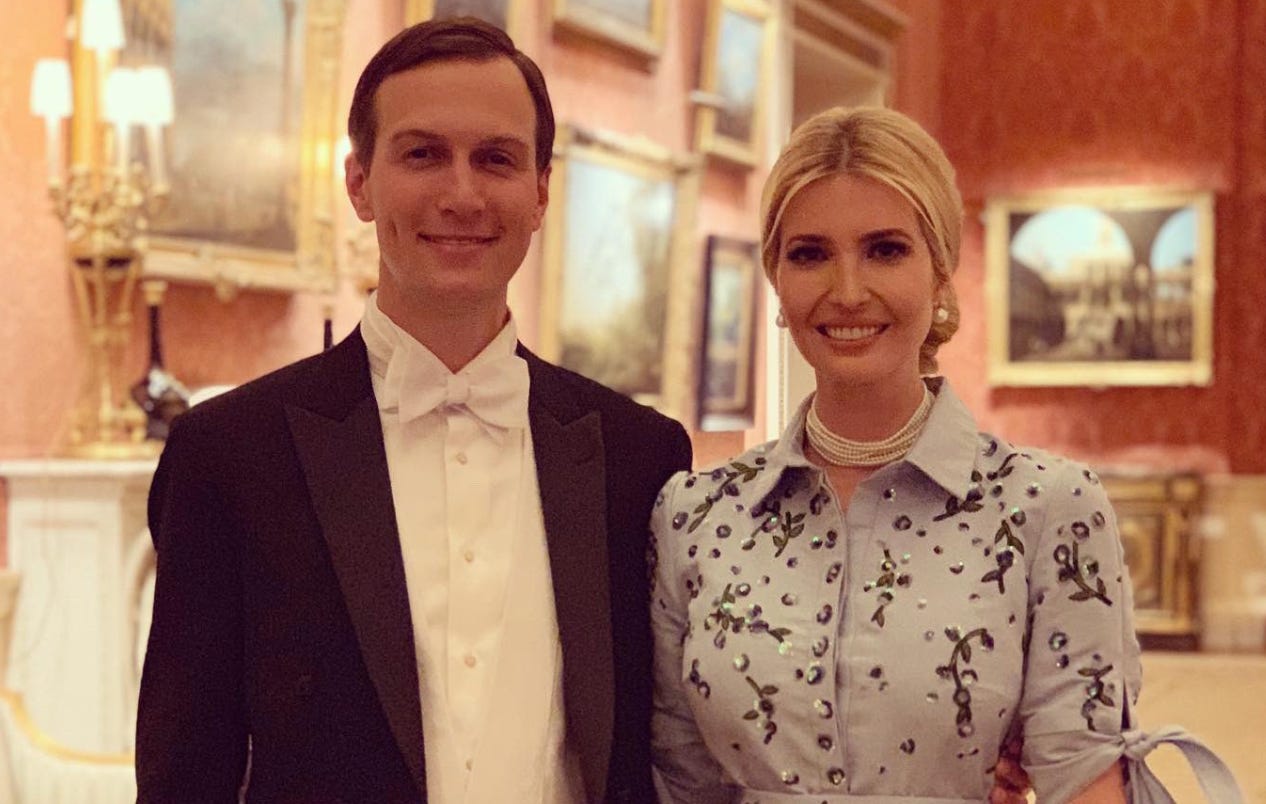
Jared and Ivanka at Buckingham Palace - @IvankaTrump
This is connected to our Zorro Ranch series, we recommend reading:
Part One | Part Two | Part Three | Part 4 | Part 5
Your subscription truly helps share this work.
If you have tips related to the Zorro Ranch and Epstein Investigation, contact:
https://nmdoj.gov/get-help/epstein-zorro-tips/
On January 21 2021, the day after the Trump administration ended, Jared Kushner incorporated a private equity firm called ‘Affinity Partners’ in Delaware. He had no prior experience in private equity and 6 months later, the Saudi Arabian sovereign wealth fund — the Public Investment Fund led by Crown Prince Mohammed bin Salman — invested 2 billion dollars into that same firm. The Saudi screening panel had recommended against it, their internal review cited the inexperience of Affinity’s management, the fact that the kingdom would bear the bulk of the investment risk, that Affinity’s operations were unsatisfactory in all aspects, and that the deal carried serious ‘public relations risks’ given Kushner’s prior White House role. MBS personally overruled his own panel and approved it anyway.
To understand how Jared Kushner and Ivanka Trump got to that moment — to the point where a foreign sovereign wealth fund would wire two billion dollars into a firm run by a man with no track record, overruling its own expert panel to do so — you have to understand the network that built the infrastructure around them. Not just the Saudi relationship, not just the Qatar blockade and the 666 Fifth Avenue bailout — the whole architecture. The real estate developers who needed governors, the financiers who blessed introductions, the political figures who took money from both and kept coming back for more.
That architecture was already operating, fully formed, many years before Jared Kushner walked into the White House. It ran through Jeffrey Epstein’s network, it ran through Forest City Ratner. It ran through a 100kacre ranch in New Mexico and a 7 story townhouse on East 71st Street in Manhattan. It ran through the same building — 666 Fifth Avenue — where Kushner Companies was headquartered and from which a business plan connecting Forest City Enterprises and the Trump Organization to Epstein’s inbox was submitted.
This is the story of the family business — all of it.
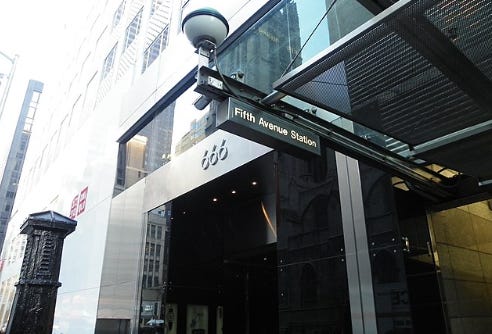
5 Av 53 St entrance — Source: The All-Nite Image Flickr
The $2 Billion Question
Affinity Partners was incorporated the day the Trump administration ended. The timeline is worth looking at: Kushner spent 4 years as a senior White House adviser with a portfolio that included nearly the entire Middle East — Saudi Arabia, Qatar, the UAE, Israel, and Palestine. He attended classified briefings, he accessed the presidential daily intelligence report, and he held meetings with foreign heads of state. He shaped arms deals, blockades, peace plans, and sovereign relationships. Kushner did all of this while simultaneously negotiating deals that would enrich his family through the governments he was ostensibly conducting policy toward.
The day that access ended, he incorporated a private equity firm. 6 months later, the government he had spent 4 years cultivating sent 2 billion dollars to that firm.
The structure of the deal guaranteed Kushner income regardless of performance. Affinity collects 25 million dollars annually in management fees from the Saudis alone, plus a profit share. By 2024, Affinity had collected approximately 175 million dollars in total fees from foreign investors, including 87 million from Saudi Arabia, while returning zero profits to any of its investors. The money was not being deployed into productive investments it was sitting. The fees kept coming.
Senate investigators concluded that Affinity’s structure bore the hallmarks of a foreign compensation scheme. One hundred percent of Affinity’s Parallel Fund is owned by non-United States persons. There are no American investors at all.
Senate Finance Committee Chair Ron Wyden launched a formal investigation and concluded that Affinity’s investors may not be motivated by commercial considerations, but rather by the opportunity to funnel foreign government money to members of President Trump’s family. His committee found that 100% of Affinity’s Parallel Fund I is owned by non United States persons, with 6 undisclosed foreign beneficial owners. The total foreign investment in Affinity reached approximately 3 billion dollars, from Saudi Arabia, Qatar, the United Arab Emirates, and Taiwanese billionaire Terry Gou. There is a 5th investor Affinity still will not identify.
In September 2025, Affinity partnered with Silver Lake and the Saudi PIF to acquire video game company Electronic Arts in a deal valued at 52.5 billion dollars — the largest leveraged buyout in history. Kushner brokered the initial connection. He holds 5% equity. The Saudis hold majority control. National security concerns that had been raised about other foreign technology acquisitions were not applied.
The Qatar Reversal: A Billion Dollar Coincidence
In April 2017, Charles Kushner — Jared’s father — made a direct pitch to Qatar’s Finance Minister for financing on the family’s most distressed asset: 666 Fifth Avenue, a Manhattan skyscraper purchased in 2007 for one-point-eight billion dollars, the highest price ever paid for a New York office tower at the time. The timing was catastrophic — the property was bleeding money, the mortgage had ballooned toward 1.4 billion dollars, and the building was 1/3 vacant. The Kushner family was looking at potential financial ruin.
Qatar said no.
One month later, Jared Kushner traveled to Saudi Arabia as part of Trump’s first diplomatic trip abroad. Days afterward, Trump publicly backed a Saudi-UAE-led blockade of Qatar — a United States military ally that hosts Al Udeid Air Base, one of America’s most critical military installations in the Middle East. Secretary of State Rex Tillerson was blindsided. He tried to mediate the crisis and was subsequently fired.
For the next year, as Kushner remained the White House’s point man on the Middle East, the Kushner family continued seeking a Qatar linked bailout for 666 Fifth Avenue. In August 2018, they got it. Brookfield Asset Management paid 1.28 billion dollars for a 99 year lease on the property, paid entirely upfront, rescuing the Kushner family from financial ruin. The Qatar Investment Authority was the second-largest investor in Brookfield Property Partners, the fund used to execute the deal. The fund contained 3billion dollars from sovereign governments, including 2billion from Middle Eastern ones.
The sequence: Kushner Companies asks Qatar for money. Qatar says no. Trump backs a Qatar blockade. One year later, Qatar-linked money rescues Kushner Companies. Two months after the bailout, Trump begins softening on Qatar.
Senate investigators found that Brookfield’s assurances that no Qatari entities were involved in the deal were false. Qatar’s sovereign wealth fund later stated it had absolutely no involvement. Both statements were contradicted by the documented structure of the fund. The limited liability company used to sign the lease was controlled by BPY, the Brookfield fund in which Qatar held a 7 percent stake.
What the Senate investigation did not document — and what the Epstein production adds — is that 666 Fifth Avenue was also the address from which a business plan connecting Forest City Enterprises and the Trump Organization to Jeffrey Epstein’s inbox was submitted. The building at the center of the Kushner family’s financial crisis was also the building from which Epstein’s network received investment pitches naming Forest City and Trump as developer clients — the same Brookfield that rescued the Kushners would acquire Forest City Enterprises in 2018. The circles close.
The Network Behind the Network: Forest City, Epstein, and the Governors
To understand the full architecture of what Jared Kushner inherited and monetized, you have to go back further than the Trump administration. You have to go back to a large ranch in New Mexico, Zorro Ranch, a campaign finance filing from 2002, and a real estate developer named David Mitchell who spent years routing introductions through Jeffrey Epstein’s personal approval.
The Ratner family’s Forest City Enterprises — the Cleveland-based real estate conglomerate that built Atlantic Yards in Brooklyn, redeveloped downtown Cleveland, and pursued a massive master-planned community called Mesa del Sol on the southern mesa of Albuquerque, New Mexico — appears in the Epstein evidentiary production at multiple levels and through multiple documented relationships.
In 2002, Forest City Covington NM LLC donated thirty thousand dollars to Bill Richardson’s gubernatorial campaign in New Mexico. On the same donor list, seven lines away, Jeffrey Epstein donated 50,000 dollars to the same campaign. This is not an allegation. It is a public campaign finance filing, confirmed in the DOJ documents EFTA00203640 through EFTA02729107, compiled from records filed with the New Mexico Secretary of State.
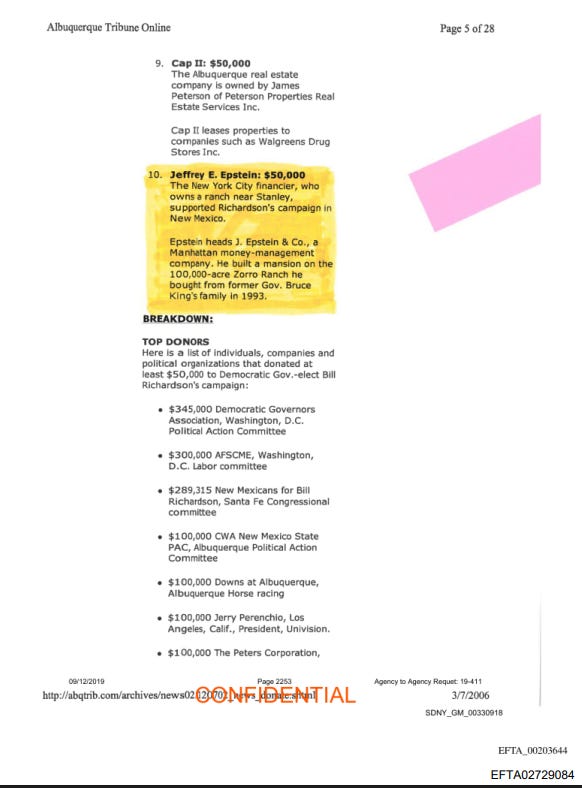
Jeffrey Epstein, $50,000 donor to New Mexico Gov. Bill Richardson. Campaign finance disclosure. — EFTA02729080
Richardson was about to become the governor of the state in which Epstein owned Zorro Ranch — a 100,000 acre compound near Stanley, New Mexico, that federal investigators would spend years documenting as a site of serious criminal conduct. Richardson was also about to become the governor whose state government Forest City needed to approve the infrastructure commitments, tax incentives, and land deals required to develop Mesa del Sol. Both Epstein and Forest City needed Richardson. Both wrote checks to his campaign in the same election cycle.
Read more on the 50k governor here. Series also linked at the top of this article.
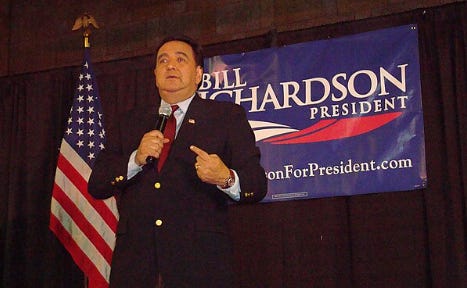
Bill Richardson on the campaign trail, 2008. He was running for President — he already knew Jeffrey Epstein. Source: Ryan Glenn
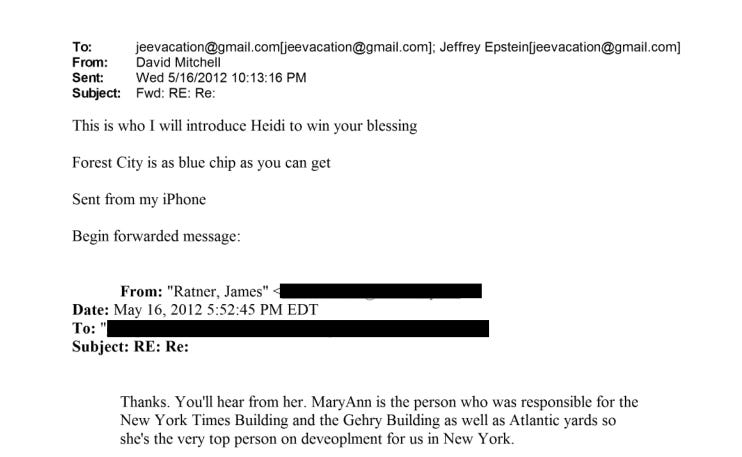
The ongoing relationship between Epstein and Forest City is documented through David Mitchell of Mitchell Holdings LLC, a New York real estate developer who served as an intermediary between Epstein and Forest City’s senior executives. In May 2012, Mitchell forwarded to Epstein’s personal email account a correspondence chain with James Ratner — a senior Forest City executive — regarding a waterfront development site in Long Island City. Mitchell’s forwarding note to Epstein read: ‘This is who I will introduce Heidi to win your blessing. Forest City is as blue chip as you can get.’ The phrase is unambiguous. A real estate introduction involving one of America’s largest developers required Jeffrey Epstein’s personal approval before it could proceed. Forest City’s legitimacy was not enough. Epstein’s blessing was the prerequisite.
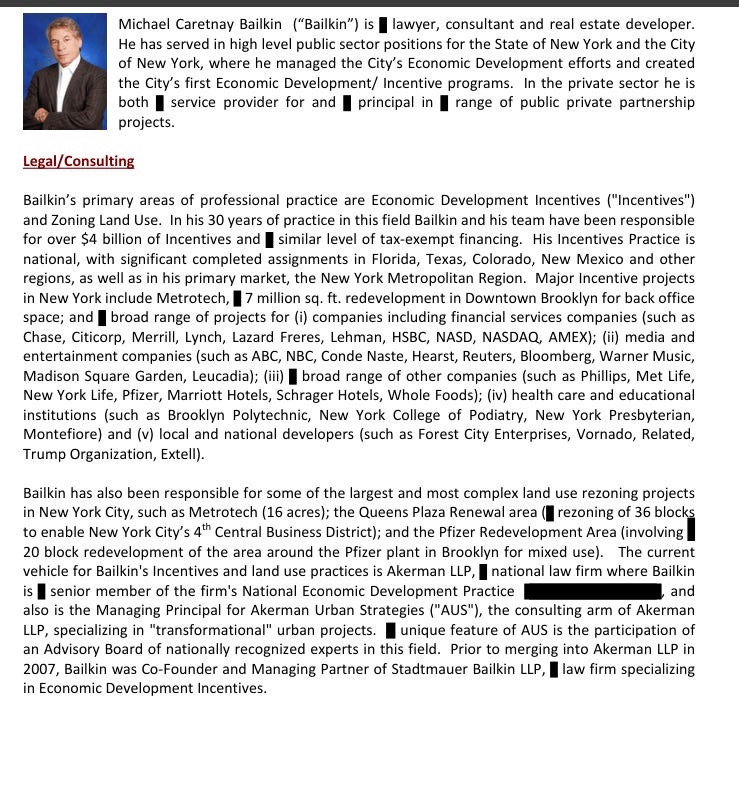
The connection to the Trump Organization runs through a business plan submitted to Epstein’s inbox from 666 Fifth Avenue — Kushner Companies’ address — by a lawyer and developer named Michael Bailkin of Arete Strategic Development. Bailkin’s biography, included in the plan, explicitly lists his economic development clients as including Forest City Enterprises, Vornado, Related, and the Trump Organization — all in the same sentence, as part of the same national incentives practice. Bailkin specifically names Metrotech, a 17mil sq ft redevelopment in downtown Brooklyn, as a project where he attracted Forest City Ratner to act as lead developer. The Trump Organization and Forest City shared the same economic development lawyer. That lawyer’s business plan landed in Epstein’s inbox, submitted from the building at the center of the Kushner family’s financial crisis.
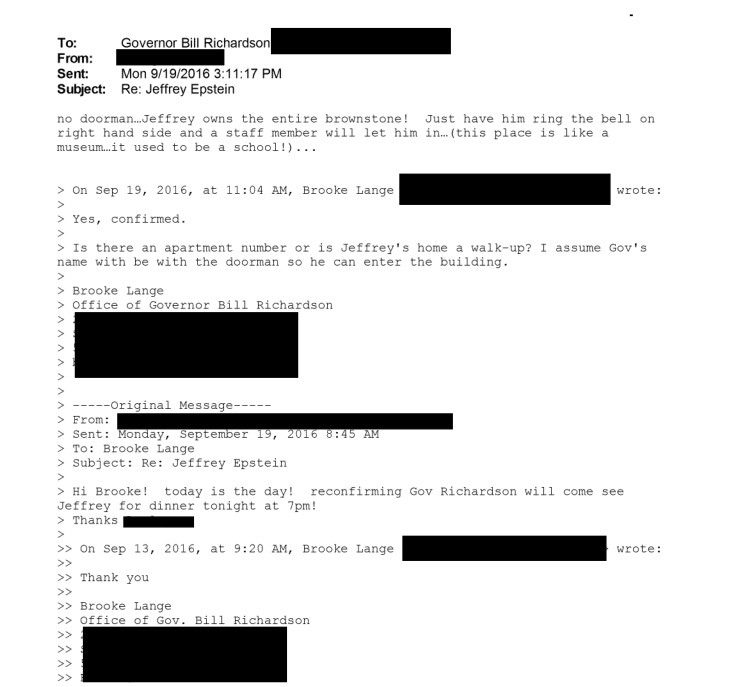
The Richardson relationship did not end with the 2002 campaign donation. The EFTA production documents it continuing across 17 years. In September 2016 — eight years after Epstein’s 2008 conviction for soliciting a minor — Richardson’s office coordinated a dinner at Epstein’s Manhattan townhouse at 9 East 71st Street. In October 2016, Richardson’s diplomatic center sent Epstein a formal funding proposal through Lesley Groff, Epstein’s personal assistant, accompanied by a personal video message from the Governor. The forwarding note from Groff to Epstein confirmed that Richardson had discussed the funding with Epstein at the September dinner. Epstein apparently made a verbal commitment. His own staff was tracking the promise a full year later. Richardson’s lawyer was on the phone to the Southern District of New York within weeks of Epstein’s July 2019 arrest, negotiating the governor’s status before prosecutors had even coordinated internally about who had spoken to whom.
This is the network Jared Kushner and Ivanka Trump operated within — not a network they created — a network they inherited, activated, and monetized at a scale their predecessors had not imagined.
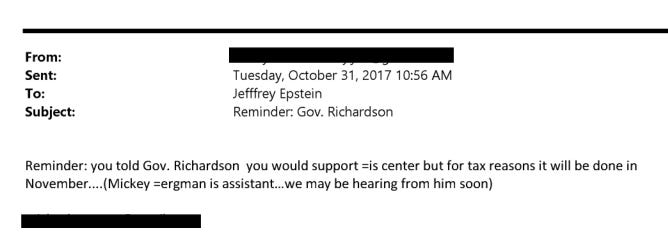
Funding proposal — EFTA02337227
The Security Clearance
When Jared Kushner applied for a top secret security clearance to serve as a White House senior adviser, two career security specialists rejected his application. The FBI background check had raised concerns about potential foreign influence stemming from his family’s business entanglements, his foreign contacts, and his foreign travel during the campaign. Their supervisor overruled them. Kushner received an interim clearance. The CIA declined to grant him access to Sensitive Compartmented Information — the most sensitive tier of classified material. He operated without a permanent clearance for over a year, all while his portfolio included Middle East policy, the Khashoggi situation, the Qatar blockade, and United States - Saudi relations.
In February 2019, the New York Times reported that Trump had personally ordered Chief of Staff John Kelly to grant Kushner a full top secret clearance. Kelly found the situation so uncomfortable that he memorialized Trump’s order in writing. White House Counsel Don McGahn also documented his objections in a contemporaneous memo. Both Trump and Ivanka Trump publicly denied the president was involved. The contemporaneous memos proved otherwise.
Intelligence officials in at least four countries had privately discussed how to manipulate Kushner using his complex business arrangements and financial difficulties — while he held a clearance that career adjudicators had twice rejected.
Intelligence officials have noted that being denied a clearance by career adjudicators takes some pretty bad stuff. The specific concerns in Kushner’s case were never made public. Intelligence officials in at least four countries had, according to reporting at the time, privately discussed how to manipulate Kushner using his complex business arrangements and financial difficulties — the same financial difficulties that were driving the search for a Qatar-linked bailout for 666 Fifth Avenue.
Despite these documented concerns, Kushner attended classified briefings, accessed the presidential daily intelligence report, and issued requests to the intelligence community — all while simultaneously negotiating deals that would enrich his family through foreign governments he was ostensibly conducting policy toward.
The Khashoggi Calculation
On October 2, 2018, journalist Jamal Khashoggi entered the Saudi consulate in Istanbul and was killed by a Saudi hit squad. The CIA concluded with high confidence that Crown Prince Mohammed bin Salman ordered the murder. The conclusion was never seriously disputed by the intelligence community.
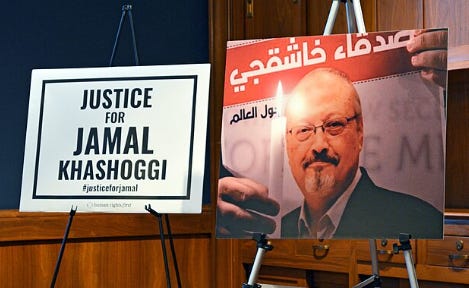
To mark the 1 yr anniversary of Jamal Khashoggi’s brutal murder, POMED and 12 other human rights and press freedom organizations held a public event on Capitol Hill to commemorate Jamal’s life, to call for accountability, and to cast a light on the Saudi government’s repression of those who are perceived to be critical of Crown Prince Mohammed bin Salman and his regime. — Source Flickr
Kushner’s response, both at the time and in subsequent years, was to protect MBS. During the immediate aftermath, Kushner offered the crown prince advice on how to weather the political storm. Inside the White House, he became, by all accounts, MBS’s most important defender. In 2020, he publicly dismissed the murder as one of a couple of missteps by Saudi Arabia, calling MBS a visionary leader doing transformational things.
When asked at a public appearance in 2024 whether he believed the CIA’s conclusion that MBS ordered the killing, Kushner first responded: ‘Are we really still doing this?’ He said he had never read the intelligence report. He then said he knew the man personally and trusted his own judgment over the agency’s.
Kushner called a murder ‘a couple of missteps.’ Six months after leaving the White House, the murderer’s government sent two billion dollars into his bank account.
The timeline is inescapable. Kushner defended MBS through a state sanctioned killing, shielded the crown prince from consequences inside the United States government, and then, within months of leaving that government, received a multi-billion dollar financial relationship with MBS’s sovereign wealth fund. No criminal wrongdoing has been established. The ethical picture is another matter entirely.
Ivanka’s China Operation
While serving simultaneously as a White House senior adviser and retaining ownership of her fashion brand, Ivanka Trump received dozens of Chinese trademark approvals in a pattern that ethics watchdogs found alarming and that federal law appeared to prohibit.
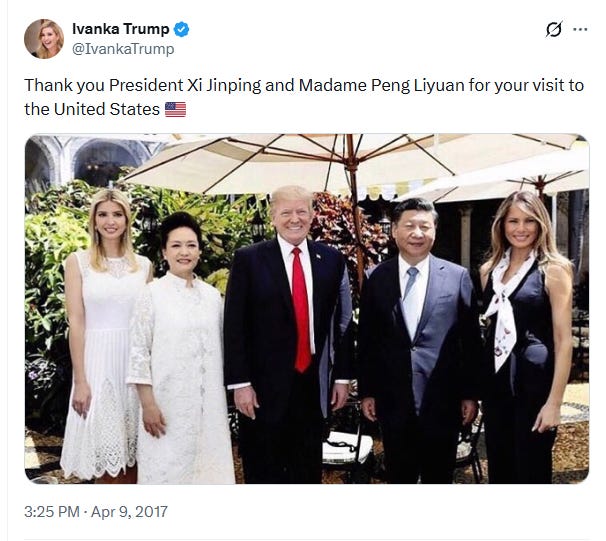
Source: @IvankaTrump
On April 6, 2017, the same day Ivanka dined with Chinese President Xi Jinping at Mar a Lago as an official White House host, the Chinese government approved three new trademarks for Ivanka Trump Marks LLC. In May 2018, she received approval for several more Chinese trademarks one week before Trump announced he wanted to lift an export ban on ZTE, the Chinese telecom company, for violating United States sanctions. By the end of 2018, China had approved more than thirty-four trademarks for Ivanka’s brand in a single year, covering handbags, shoes, jewelry, wedding dresses, baby blankets, coffins, nursing homes, and voting machines.
Federal ethics rules prohibit senior White House officials from participating in any decision, approval, or advice on matters that will directly affect their own financial interests. Each willful violation carries a penalty of up to five years in prison. Ivanka’s brand continued seeking and receiving foreign government intellectual property grants while she was simultaneously meeting with foreign leaders and shaping trade policy. The Office of Government Ethics found that she was the worst offender among White House officials in her use of personal email for government business — hundreds of emails about official White House matters sent from a private account, discovered not through White House disclosure but through FOIA litigation by the watchdog group American Oversight.
The irony required no elaboration. Her father’s 2016 campaign had been built, in significant part, around the slogan Lock her up, directed at Hillary Clinton for using a private email server. The methodology for reviewing the emails was identical, the political response was not.
The Near-Indictment: Trump SoHo
The documented record of Ivanka Trump’s proximity to legal jeopardy predates the White House by nearly a decade. In 2010, the Major Economic Crimes Bureau of the Manhattan District Attorney’s office opened a criminal investigation into Ivanka Trump and Donald Trump Jr. for misleading prospective buyers of units at Trump SoHo, a hotel condo development in lower Manhattan. The development was failing. By 2008, only 15.8 percent of units had actually sold. The Trumps told prospective buyers sixty percent had been purchased. They told a trade publication 55 percent. They told the press 31 percent.
Prosecutors found emails in which Ivanka and Donald Jr. discussed how to coordinate the false information they had given to buyers. Four people who reviewed the emails told ProPublica there was no doubt the siblings approved, knew of, agreed to, and intentionally inflated the numbers to make more sales. One source said: They knew it was wrong.
The case ran for two years, an indictment was approaching. Defense lawyers could not make the evidence go away. Then Donald Trump’s personal lawyer, Marc Kasowitz, entered the case. He bypassed the career prosecutors entirely and went directly to Manhattan District Attorney Cyrus Vance Jr. He brought no new arguments, he simply repeated what the defense lawyers had already said unsuccessfully. Three months after that meeting, Vance overruled his own prosecutors and ordered them to drop the case. Kasowitz had donated 25 thousand dollars to Vance’s reelection campaign that year. Within six months of the case being dropped, Kasowitz helped raise fifty thousand dollars more for Vance.
An indictment was approaching. The Trump family’s lawyer met privately with the DA who had received substantial campaign donations. The case was dropped. The Trumps also extracted an unusual condition from the civil settlement: the plaintiffs agreed not to cooperate with prosecutors unless subpoenaed.
The Trumps settled the civil suit brought by defrauded buyers, agreeing to return ninety percent of their deposits. As part of the settlement, they extracted an unusual condition: the plaintiffs agreed not to cooperate with prosecutors unless subpoenaed. The near indictment and its resolution established a pattern that would define the family’s relationship with legal accountability for the next fifteen years.
The West Bank Donation
While Jared Kushner was serving as the Trump administration’s lead official on Israeli-Palestinian peace negotiations, the Kushner Companies Charitable Foundation was donating at least eighteen thousand dollars to American Friends of Bet El Yeshiva — an organization that funds the construction of Bet El, an Israeli settlement built on private Palestinian land seized by the Israeli military in the 1970s. Bet El is among the most politically radical settlements in the West Bank. The former president of the Bet El fund was David Friedman, whom Trump subsequently appointed as United States Ambassador to Israel.
The Trump administration’s formal peace plan, drafted in significant part by Kushner, adopted the Israeli government’s position on nearly every major issue. It called for Israel to annex approximately thirty percent of the West Bank where most Israeli settlers live. The Palestinian Authority refused to negotiate on this basis. The Kushner family continued funding the settlements the plan would have annexed into Israel. Following the White House years, Kushner’s Affinity Partners announced its first Israeli investment: a 150 million dollar minority stake in an Israeli car company. Affinity described the firm as an investment corridor between Saudi Arabia and Israel. The relationships built during four years of Middle East policy, using American diplomatic leverage and classified intelligence, were being monetized directly through the same investment firm receiving Saudi government money.
The Through Line
The story of Ivanka Trump and Jared Kushner in government is, at its core, a story about the privatization of foreign policy. A man with no intelligence background, no diplomatic experience, and no financial track record was handed the Middle East. The relationships he built with Saudi Arabia, Qatar, the UAE, and Israel — using American government resources, classified access, and the full weight of presidential authority — were then converted directly into a private equity firm that those same governments fund.
But the story does not begin with Jared Kushner. It begins with the network he stepped into — a network in which real estate developers needed governors, financiers blessed introductions, political figures took money from both and kept coming back for more, and the same building at 666 Fifth Avenue sat at the intersection of the Kushner family’s financial desperation and the architecture of access that Jeffrey Epstein had been constructing for decades.
Forest City Enterprises, which donated thirty thousand dollars to Bill Richardson’s gubernatorial campaign in the same election cycle as Epstein’s 50k donation, was acquired by Brookfield Asset Management in 2018. The same Brookfield that had rescued the Kushner family’s 666 Fifth Avenue through a 1.28 billion dollar deal funded in part through the Qatar Investment Authority. The same Qatar that had refused to bail out the Kushners directly in 2017, and whose blockade Jared Kushner helped engineer one month after that refusal.
Ivanka functioned as a parallel operation, using her position to maintain and expand her brand’s commercial footprint in China while her father waged a trade war with Beijing. She violated federal records law, she received foreign intellectual property grants in apparent coordination with diplomatic events, she was nearly indicted for fraud a decade earlier, and that case evaporated under circumstances that remain, at minimum, suspicious.
None of this produced a criminal conviction. The systems that exist to prevent it — security clearance reviews, ethics offices, federal records law, congressional oversight, conflict of interest statutes — were either overridden, ignored, or stonewalled at each turn. The pattern held from the Trump SoHo near-indictment through the White House years through the post-administration foreign money flows. The family business was always the White House. The network that made the White House possible was already in place. The White House just didn’t know it was the product.
What you’re left with is a couple who entered the White House worth an estimated 740 million dollars and left it with Kushner’s net worth at least 900 million dollars — up 180 percent by the time Forbes measured it in 2024, almost entirely on the strength of money from the governments he had spent four years setting policy toward. And a network, built across decades by figures whose names appear in federal evidentiary productions, that made the access possible, maintained the relationships, blessed the introductions, and kept the governors and the developers and the financiers circling the same buildings, the same accounts, and the same names, year after year, until someone finally followed the paper trail all the way to the end.
Last Page First is reader-funded investigative journalism. Every article is built on primary documents — the actual federal records, the actual FBI interviews, the actual emails. No speculation. No unnamed sources. Just the paper trail.
If this work matters to you, please share it, restack it, and consider becoming a paid subscriber. Paid subscribers get access to the Document Room — where the primary sources behind every article live, searchable and sourced.
If you have tips related to the Zorro Ranch and Epstein Investigation, contact:
https://nmdoj.gov/get-help/epstein-zorro-tips/
Primary Sources
AFFINITY PARTNERS / SAUDI INVESTMENT
QATAR BLOCKADE / 666 FIFTH AVENUE
SECURITY CLEARANCE
KHASHOGGI
IVANKA CHINA TRADEMARKS / EMAIL
Ivanka Chinese Trademarks — CREW| 3 trademarks same day as Xi dinner; 34 trademarks in 2018
Ivanka Granted 7 Trademarks — CNN/news8000 May 2018 | ZTE sanctions context; ethics experts quoted
TRUMP SOHO NEAR-INDICTMENT
Near Fraud Indictment — Daily Beast | ‘They knew it was wrong’
WEST BANK / SETTLEMENTS
FOREST CITY / EPSTEIN / RICHARDSON NETWORK — EFTA PRIMARY SOURCES
‘Win Your Blessing’ Email — EFTA02017848–EFTA02017850; EFTA00934747 | Mitchell to Epstein routing Forest City introduction through personal approval
Richardson Funding Proposal — EFTA00461948; EFTA00438158; EFTA02337227 | Formal proposal; Gobernador New Mexico.avi; verbal commitment documented
Brookfield Acquires Forest City — 2018 public record | Same Brookfield that executed 666 Fifth Avenue rescue through Qatar-linked funds
You forgot Thornburg. Garrett Thornburg came from Bear Sterns like Epstein. He was good buddies with Bill Richardson. That’s listed on those exact same campaign contributions.
And all the neoliberals or libertarians want a piece of pie.
https://substack.com/@thedreydossier/note/p-194101283?r=2kypnw&utm_medium=ios&utm_source=notes-share-action