
The Plan Published in 1982
What the Yinon Plan, a Four-Star General, and 30 Years of Congress tell us about Iran

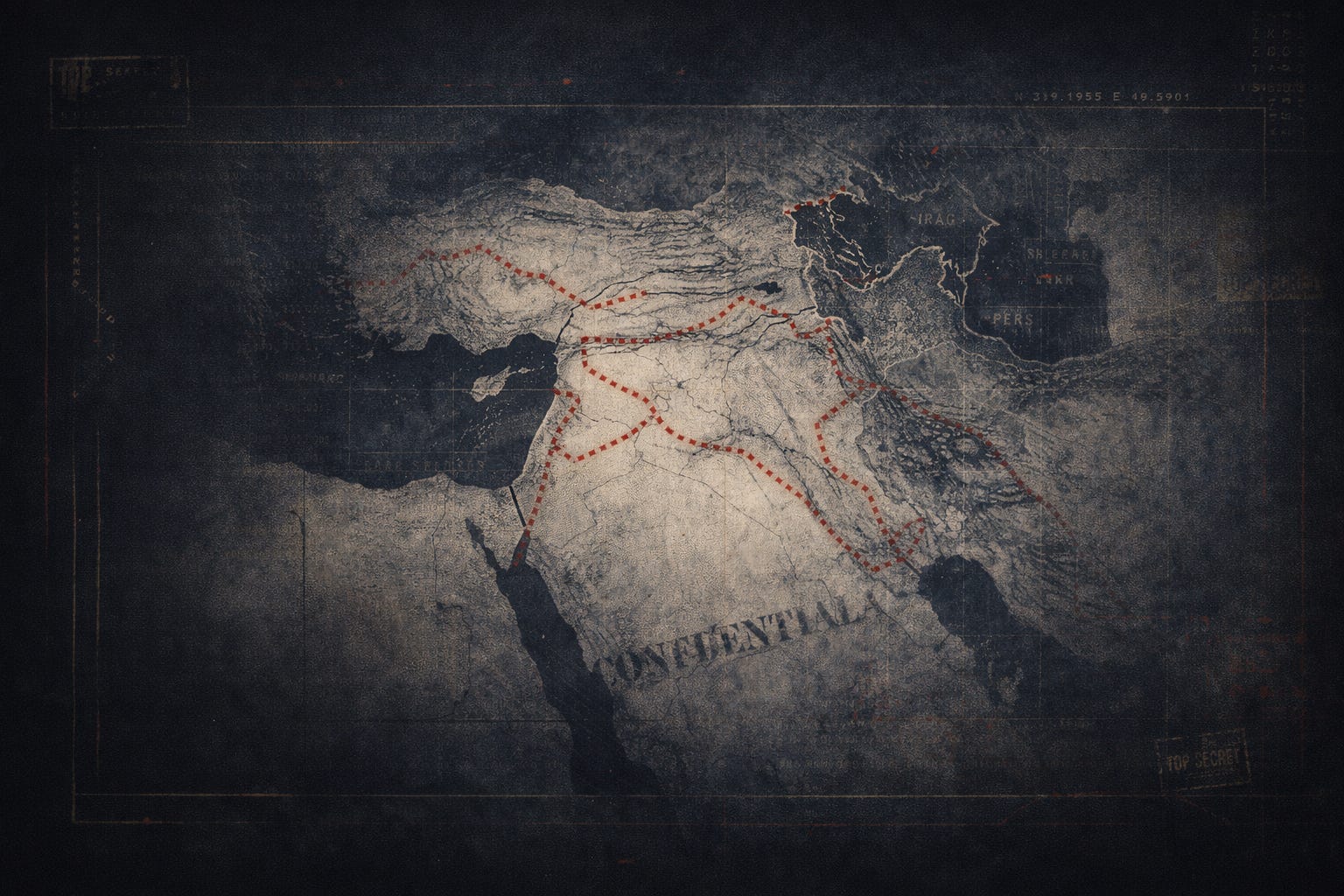
Before the bombs fall, a blueprint exists
That is not a theory. It is a documented historical pattern that has repeated across the Middle East for over forty years. If you want to understand what is happening to Iran right now, truly, you need to read one document, watch one interview, and follow one money trail.
After that, the official explanation becomes very difficult for one to believe.
The Yinon Plan
In 1982, an Israeli journalist and government official named Oded Yinon published a strategic document titled “A Strategy for Israel.” It appeared in Kivunim, a Hebrew-language journal connected to the World Zionist Organization.
The document is not classified. It is not hidden. It is publicly available and has been translated into English. You can read it today.
The central argument of the document is this: Israel’s long term security depends not on military strength alone- but on the fragmentation of surrounding Arab states into smaller, weaker, ethnically and religiously divided entities that cannot pose a unified threat.
The countries it named were not random. Iraq. Lebanon. Jordan. Egypt. Syria. Iran. Read that list again. Now go and watch the news.
Every single one of those countries has experienced exactly that since 1982.
That is not interpretation. That is the documented record of forty years of Middle Eastern history placed next to a document that predicted it.
Read the document, then read the history. Then decide what you believe.
The General Told Us
In 2007, retired US Army General Wesley Clark, former Supreme Allied Commander of NATO, gave an interview that should have changed everything.
He described visiting the Pentagon shortly after September 11th 2001, where a senior military officer showed him an internal memo.
“This is a memo that describes how we’re going to take out seven countries in five years, starting with Iraq, and then Syria, Lebanon, Libya, Somalia, Sudan and, finishing off, Iran.”
- General Wesley Clark, former Supreme Allied Commander NATO, 2007
Watch General Wesley Clark describe the Pentagon memo in full, unedited context in his 2007 interview with Amy Goodman on Democracy Now!
This is not conspiracy. This is not a leak. This is a decorated four-star general describing what he was shown, on camera, in his own words. The interview is publicly available on YouTube. It has never been credibly disputed.
Clark describes a Pentagon memo. The Yinon Plan is a separate document. But place them side by side. A 1982 Israeli strategy paper identifies the exact same targets. A 2001 Pentagon memo describes plans to act against them. The overlap is not a coincidence you are imagining. It is there on the page. The timeline took longer than five years. But the list has been followed with devastating consistency.
The Money That Buys the Policy
The American Israel Public Affairs Committee, AIPAC, is one of the most powerful lobbying organizations in Washington. This is not disputed by anyone who has studied American foreign policy seriously.
For decades AIPAC has directed campaign contributions toward candidates who support Israeli foreign policy goals and away from those who do not. The financial influence is documented, traceable, and legal under current US campaign finance law.
The result is a Congress that has, with rare exception, supported every military intervention in the Middle East that aligned with the strategic goals outlined in the Yinon Plan. Regardless of which party held power. Regardless of the human cost. Regardless of whether the stated justification proved true.
Iraq had no weapons of mass destruction. Libya was not saved. Syria was not freed. The pattern is consistent.
Freeing the People
Every intervention arrives with a “humanitarian” explanation. The people are oppressed! The regime is evil! We are bringing freedom to the people!
These explanations are not always entirely false. The regimes targeted are often genuinely authoritarian, but authoritarian governments the United States has no strategic interest in destabilizing are left entirely alone, or are actively supported.
The selective application of humanitarian concern follows the Yinon map with a precision that is difficult to explain as simply coincidence.
Iran is the final country on that 1982 list. It is now the subject of escalating military and economic pressure. The explanation being offered to the public is the same one that preceded every previous intervention before.
You do not have to believe any particular theory about who is directing events to find this pattern significant. You only have to read the documents that already exist, in plain language, in public.
A documented strategic plan published in 1982, echoed in a Pentagon memo described by a senior NATO general in 2007, funded through traceable lobbying money over thirty years, appears to be reaching its final chapter. The public explanation being offered does not account for any of this.
The Yinon Plan is not a conspiracy theory. It was published. You can read it. The question is whether you will.
Last Page First is an independent investigative publication. Paid subscribers make the deep dives possible—FOIA templates, citation indexes, Document Room access, and subscriber discussion threads. If this piece reached you, share it. If you want to help keep it going, subscribe.
If you have documents, names, or anything relevant to an investigation, my inbox is open to everyone. Contact us here. Your name stays private unless you tell me otherwise.
Sources
Oded Yinon, “A Strategy for Israel in the Nineteen Eighties” — originally published in Kivunim (Directions), Issue No. 14, February 1982. Translated into English by Israel Shahak. Published by the Association of Arab-American University Graduates, Belmont, Massachusetts, 1982.
Full English text — Internet Archive archive.org/details/astrategyforisraelinthenineteeneighties
Full English text — Internet Archive (PDF) archive.org — PDF
Wikipedia — Yinon Plan (historical context and scholarly reception) en.wikipedia.org/wiki/Yinon_Plan
General Wesley Clark Interview
General Wesley Clark describing Pentagon memo — Democracy Now!, March 2, 2007 democracynow.org/2007/3/2/exclusive_general_wesley_clark_weighs_in
AIPAC Campaign Finance Records
Federal Election Commission public database fec.gov/data