
The Room Is Closing In
Who Is Being Deposed, Who Just Lost Their Job, and Why the Epstein Files Are Far From Over.

By Last Page First | March 7, 2026
Editor's Note: This piece is a dispatch, a status report on where the Epstein investigation stands as of this week, who is testifying, and where Last Page First is in its ongoing series. Parts 2 and 3 of that series coming soon.
This week, something shifted
Not in a dramatic, movie finale way. In the way these things actually move: a subpoena approved on a 24-19 vote, a lawyer forced to resign, a set of FBI interview memos that went missing and then, under pressure, quietly reappeared. The room is not empty, but it is getting smaller.
I launched Last Page First with a single article about the survivors who brought Epstein down and were then consumed by the system they trusted. The response told me something: people are paying attention, and they are hungry for someone to connect the threads rather than report each document drop in isolation.
So here is the thread. Here is where the investigation stands. Here is who is sitting across from congressional investigators right now, and who should have been there years ago.
THE FILES THEY SAID WERE DUPLICATE
Let's start with what broke this week, because it is a near-perfect microcosm of everything wrong with how this investigation has been managed.
The Department of Justice released millions of pages of Epstein files under the Epstein Files Transparency Act signed in November 2025. Among those files were supposed to be FBI 302 memos, the written records of every witness interview agents conducted. A CNN analysis found that dozens of those 302s were missing from the public archive. Among the missing: three separate interviews with a woman from South Carolina who told FBI agents she was sexually abused by Epstein starting at age 13 and who, in a follow-up interview, alleged that Epstein introduced her to Donald Trump, and that Trump sexually assaulted her.
The DOJ's explanation: the files were "incorrectly coded as duplicative." Fifteen documents, they said. A clerical error.
The DOJ said the missing 302s were a clerical error. That explanation is harder to accept when you know that a separate catalog of Maxwell case evidence, also released by DOJ, listed those exact interviews. They knew the files existed. They released a log showing they existed. They did not release the files.
When the files were finally posted, after NBC News identified the gap using the Maxwell evidence catalog and after NPR's investigation found the same, the White House dismissed the underlying allegations as baseless, and noted that the Biden DOJ had the same files for four years and did nothing with them. That much is true. Which is precisely the problem. The pattern of institutional inaction is not partisan. It is structural.
For readers following my series: this is the exact pattern we will be covering in Part 2. A classified FBI file opened in December 1997. Case title: restricted. Nine years of silence before Operation Leap Year. Now, in 2026, 302 interview memos "accidentally" withheld until journalists with evidence catalogs made them impossible to ignore. Same agency. Same pattern. Twenty-nine years apart.
THE ATTORNEY GENERAL IS SUBPOENAED
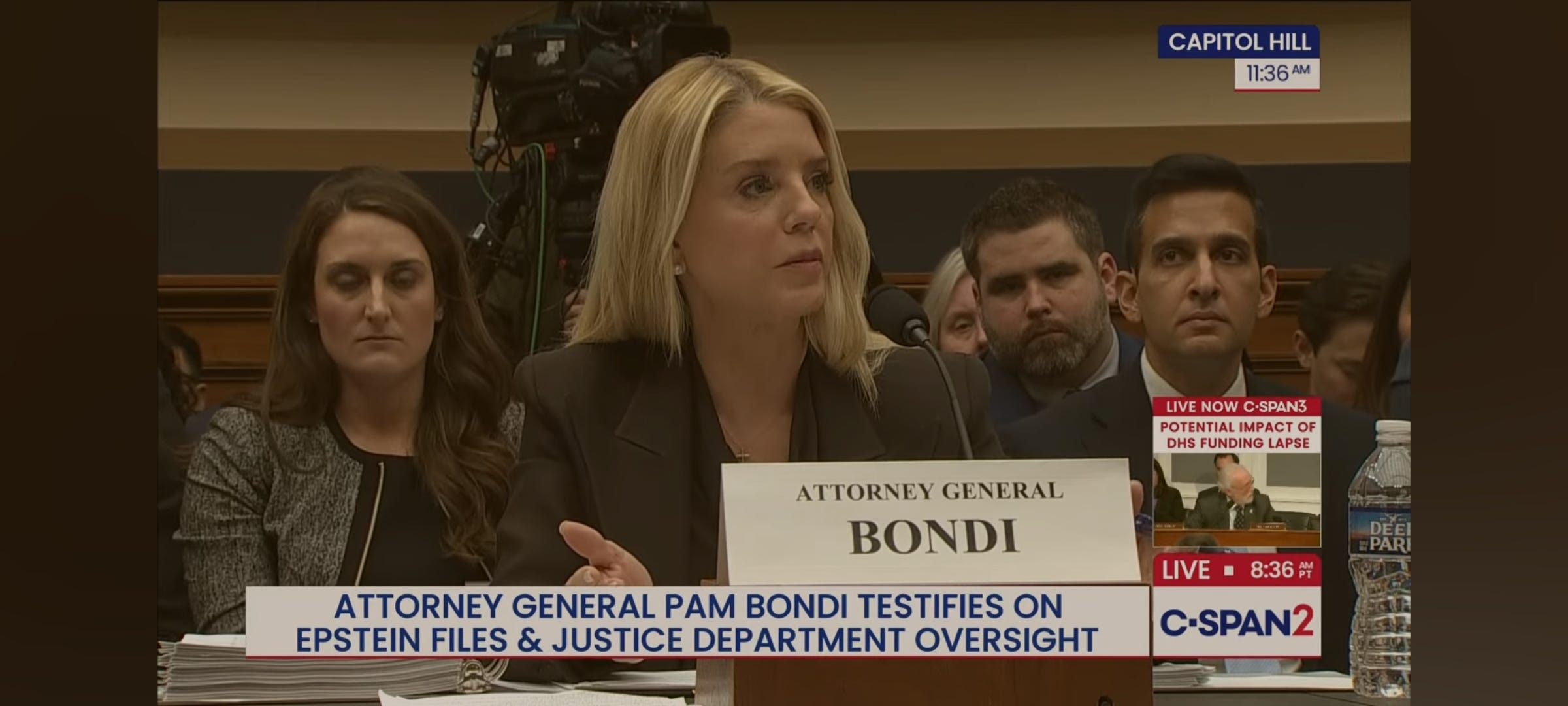
On March 4, 2026, the House Oversight Committee voted 24-19 to subpoena Attorney General Pam Bondi.
Five Republicans crossed the aisle to approve it. That matters. This is not a partisan battle over Epstein's files anymore. It is a bipartisan acknowledgment that the DOJ has not met its legal obligations under the Transparency Act.
The DOJ's public position is that it has released everything it is required to release, approximately 3.5 million documents. But the department itself has acknowledged that as many as 6 million pages may qualify as responsive under the law. The 302 memos issue only deepened the credibility problem. Bondi has also not charged a single additional person in connection with Epstein's trafficking network, a fact Rep. Jerry Nadler raised directly in a judiciary hearing, prompting Bondi to suggest the committee should be focused on the stock market instead.
A new batch of documents is expected “fairly soon,” according to a person familiar with the matter cited by MS Now. That release will come while the AG is under a congressional subpoena. That is not a coincidence. That is pressure working.
WHO IS IN THE ROOM
Here is the full current roster of people who have testified, are scheduled to testify, or have agreed to voluntary transcribed interviews with the House Oversight Committee. Read this list slowly.
Already Testified:
→ Bill Clinton and Hillary Clinton, February 2026. Clinton testified he saw nothing and did nothing wrong. The committee has documentation suggesting he flew on Epstein's planes more times than he has acknowledged.
The released deposition transcripts reveal what was actually asked. During Bill Clinton’s questioning, a committee member asked directly whether Huma Abedin had ever traveled on Epstein’s plane. Clinton answered: “I don’t know. She might have taken one of the trips with us, but I don’t know.” He confirmed Abedin had been “a part of our family for a very long time” and could not confirm or deny whether she flew alongside him and Epstein. He was also unable to say whether he had traveled with both Epstein and Abedin together. That is a non-answer given under oath. During Hillary Clinton’s deposition, Rep. Lauren Boebert asked whether any released Epstein files related to the Podesta emails or Pizzagate. Clinton’s counsel called it the “wacky Pizzagate scandal.” Clinton said it was “totally made up.” Rep. Robert Garcia, the ranking Democrat, publicly criticized colleagues for raising debunked conspiracy theories instead of focusing on the documented record. Both lines of questioning are now part of the official congressional record.
→ Les Wexner, February 18, 2026. Deposed at his New Albany, Ohio home by five House Oversight Democrats. Wexner, the billionaire founder of L Brands, gave Epstein a power of attorney in 1991, a $13.2 million Manhattan townhouse he never substantially lived in, and access to his corporate infrastructure. The FBI listed him as a secondary co-conspirator in a 2019 internal email. He revoked the power of attorney in September 2007, the same month Epstein's non-prosecution agreement was signed.
→ Richard Kahn, February 25, 2026. Epstein's longtime accountant. Co-executor of Epstein's estate. Under the terms of Epstein's final will, signed two days before his death, Kahn was set to receive $25 million. He and attorney Darren Indyke recently agreed to a $35 million settlement with Epstein survivors alleging they facilitated the trafficking network.
Scheduled or Agreed to Testify:
→ Darren Indyke, scheduled March 5, 2026. Epstein's personal attorney for over three decades, exclusively employed by Epstein by the 1990s. Under Epstein's will, Indyke was set to receive $50 million. He co-signed the will eight days after Epstein's death. The committee has documentation tying Indyke to alleged sham marriages used to control women in Epstein's network for immigration purposes.
→ Bill Gates, voluntarily agreed to transcribed interview. Gates has acknowledged his relationship with Epstein was a “huge mistake” aimed at philanthropic fundraising. Newly released DOJ documents reveal a more frequent cadence of contact than Gates had previously disclosed.
→ Leon Black, voluntarily agreed to transcribed interview. (See below.)
→ Kathryn Ruemmler, voluntarily agreed to transcribed interview. (See below.)
→ Howard Lutnick, Commerce Secretary, voluntarily agreed. Lutnick was Epstein's neighbor in New York and admitted in a separate Senate hearing that he visited Epstein's home. He had previously claimed he cut off contact with Epstein years before that visit.
→ Ted Waitt, billionaire co-founder of Gateway Computers, voluntarily agreed.
→ Doug Band, longtime personal counselor to Bill Clinton, agreed to interview.
→ Lesley Groff, Epstein's longtime executive assistant, agreed to interview.
→ Sarah Kellen, former Epstein assistant, agreed to interview. Kellen has been identified in multiple civil cases as one of the women who actively recruited and managed victims.
LEON BLACK: $170 MILLION AND A LOVE POEM
Leon Black is the co-founder of Apollo Global Management, one of Wall Street's most powerful private equity firms, with assets under management in the hundreds of billions. He is also the man who paid Jeffrey Epstein $170 million after Epstein was a convicted sex offender.
The initial figure, revealed by a 2021 Dechert LLP investigation commissioned by Apollo's own board, was $158 million, described as payment for tax and estate planning services between 2012 and 2017. That was already an extraordinary number. The median compensation of a Fortune 500 CEO during that period was approximately $13 million annually. Black was paying Epstein that and more, every year, for services other financial advisors were providing at a fraction of the cost.
Senate Finance Committee investigators, led by Senator Ron Wyden, subsequently discovered the real figure: $170 million. Twelve million dollars the Apollo board's own investigation failed to identify.
When confronted about the payments, Black's response was that the sum was immaterial against his total wealth. He compared it to an average family gaining or losing about $1,152 in a day.
That framing tells you exactly who Leon Black is.
There is more. In 2003, Black contributed a handwritten poem to a birthday tribute album assembled by Ghislaine Maxwell for Epstein's 50th birthday. The poem included the acronym V.F.P.C. - "Vanity Fair Poster Child" - a reference to a profile then being written about Epstein. The poem contained lines about women described as "spread out geographically" and referenced Epstein as "The Old Man and The Sea." He signed it: "Love and kisses, Leon."
Black resigned from Apollo's CEO role in 2021 following the Epstein revelations. He has been accused of rape by multiple women, with at least one alleged assault taking place in Epstein's Manhattan townhouse, the same house Les Wexner once owned. In 2021, a lawsuit was filed alleging he violently sexually assaulted a 16-year-old girl with Down syndrome and autism in that property in 2002. Black has denied all sexual misconduct allegations and has never been charged.
Wyden's investigation also found that a major U.S. financial institution waited nearly seven years to report Black's payments to Epstein to the Treasury Department, a potential violation of federal money laundering laws. That institution has not been named publicly. Black settled a lawsuit with the U.S. Virgin Islands attorney general for $62 million, which provided him immunity from criminal prosecution in that jurisdiction.
He has agreed to a voluntary transcribed interview with the House Oversight Committee. He is not under subpoena. He will appear at a time of his choosing, with his lawyers present, and answer questions he has spent years preparing for.
KATHRYN RUEMMLER: “UNCLE JEFFREY” AND THE NIGHT HE WAS ARRESTED
Kathryn Ruemmler was, until February 2026, the Chief Legal Officer of Goldman Sachs. Before that, she was President Obama's White House Counsel. Before that, she was a federal prosecutor who helped convict the Enron executives. She is, by any conventional measure, one of the most accomplished lawyers in the United States.
She is also the person Jeffrey Epstein called the night he was arrested.
On July 6, 2019, minutes after being picked up at Teterboro Airport, Epstein placed a call to Ruemmler's cellphone at 7:15 PM. Notes from law enforcement riding in the FBI vehicle that night, released as part of the DOJ's Epstein file dump, record Epstein's words in that moment. "Oh this is bad," the notes quote him saying. "This is really bad."
Ruemmler has said she never formally represented Epstein. The DOJ files make the nature of their relationship harder to characterize so cleanly. Emails released in the January 2026 document drop show a relationship that spanned years and covered strategy, reputation management, and personal matters. She called him "Uncle Jeffrey," "sweetie," and "wonderful Jeffrey." She signed emails with "xo" and "xoxo." She thanked him for a $9,400 Hermès bag, a Fendi fur-trimmed coat, Bergdorf Goodman gift cards, spa visits, Broadway tickets, and flowers.
In one 2019 email, four months before his arrest, she advised Epstein on how to respond to press coverage of his 2008 non-prosecution agreement and the special treatment he received from then-U.S. Attorney Alex Acosta. She was helping him manage the public narrative of his crimes while working as a partner at Latham & Watkins.
She was also, according to released documents, listed as a backup executor in a January 2019 version of Epstein's will.
The DOJ files also revealed that Ruemmler forwarded to Epstein a series of emails from the wife of Reid Weingarten, one of Epstein’s defense attorneys, accusing Ruemmler of having an affair with her husband. The connection is worth noting: Weingarten had originally introduced Ruemmler to Epstein, and had transferred at least one Epstein-adjacent client, the Swiss bank Edmond de Rothschild Group, to Ruemmler’s practice at Latham. The tangled web of professional loyalty, personal intimacy, and legal cover in Epstein’s orbit is not incidental to how he operated. It is how he operated.
Ruemmler announced her resignation from Goldman Sachs on February 12, 2026, effective end of June. She was asked by the House Oversight Committee to testify on March 3. She agreed voluntarily.
She has said, repeatedly, that she regrets ever knowing Jeffrey Epstein. That is a statement about her career. The women in those case files would describe their regret differently.
THE WIDER FALLOUT
The Epstein files have now claimed a growing list of professional casualties and are actively reshaping the contours of what is publicly known about the network around him. A brief accounting:
→ Brad Karp, chairman of the major corporate law firm Paul Weiss, resigned from that post (though he is staying at the firm) after email exchanges between him and Epstein were released. Epstein had looped Karp into communications about his legal strategy as early as February 2019.
→ Morgan Sweeney, Chief of Staff to British Prime Minister Keir Starmer, resigned in connection with advice he gave regarding Peter Mandelson, the former UK ambassador to the U.S. who was fired over his own Epstein connections.
→ Thomas Pritzker, Executive Chairman of Hyatt Hotels, resigned from Hyatt's board in February 2026, citing “terrible judgment” in maintaining contact with Epstein and Maxwell.
→ Apollo Global Management itself is now the subject of a proposed shareholder class action filed in the Southern District of New York, alleging that Apollo and its co-founders concealed the extent of Black's Epstein ties from investors, contributing to approximately a 15% slide in share price over three weeks in February 2026, roughly $12 billion in market capitalization.
→ The American Federation of Teachers has formally asked the SEC to investigate Apollo's past disclosures.
Also still pending: depositions of Indyke and Kahn in connection with their $35 million settlement with Epstein survivors, a settlement that still requires judicial approval, and which their attorneys have been careful to note does not constitute an admission of wrongdoing.
WHERE LAST PAGE FIRST IS IN THIS
I want to be transparent about where I am in this investigation and what is coming.
Part 1 of this series is published. It is about the survivors who brought Epstein to justice and were systematically failed by the institutions they trusted.
Part 2 publishes Monday March 9, 2026. It is about a classified FBI document, case number EFTA01683603, classification SECRET//NOFORN, opened on December 19, 1997. A full investigation. Cross-filed under Epstein, Jeffrey: Child Sex Trafficking. Opened fifteen months after Maria Farmer filed her complaint. Nine years before the FBI told the world it first became interested in Jeffrey Epstein. The case title is still restricted in the public release.
Part 3 follows closely. It is about the infrastructure of protection: the townhouse, the power of attorney, the lawyers, the security, the properties, the money, and how one man was made untouchable by the people who surrounded and enabled him.
I am a one-person operation. I am not a wire service. I am not going to publish first and verify later. What I publish, I can stand behind. Everything in this series is sourced to primary documents, court records, or confirmed reporting from named journalists.
My working thesis for Part 4 is the one question that still does not have a satisfactory answer: how did he die in a federal facility, under suicide watch, with guards asleep and cameras malfunctioning, eight days after updating his will? And what has happened since to ensure that no one who might know something is ever seriously compelled to say it under oath?
We are getting closer to that answer. Not because justice moves quickly. Because the room is getting smaller, and the people left in it are running out of places to stand.
Last Page First is an independent investigative publication. Paid subscribers make the deep dives possible—FOIA templates, citation indexes, Document Room access, and subscriber discussion threads. If this piece reached you, share it. If you want to help keep it going, subscribe.
If you have documents, names, or anything relevant to an investigation, my inbox is open to everyone. Contact us here. Your name stays private unless you tell me otherwise.
PRIMARY SOURCES REFERENCED
→ EFTA01683603 — 1997 SECRET//NOFORN Full Investigation (direct PDF — age verification on first click)
→ NPR: DOJ posts more Epstein files related to Trump allegations
→ CNN: Justice Department posts FBI interview memos related to Trump allegation
→ CNBC: Goldman Sachs’ Ruemmler, Bill Gates, Leon Black will testify
→ CNN: Kathy Ruemmler and Epstein — inside the Goldman Sachs lawyer’s ties
→ WSJ / Tovima: When the FBI arrested Epstein, he called Kathryn Ruemmler
→ Senate Finance Committee: Wyden on Leon Black and Epstein payments ($170 million)
→ CBS News: Wexner, Indyke, Kahn subpoenaed by House Oversight
→ CNBC: Epstein files — Goldman Sachs Kathy Ruemmler to step down
Last Page First is an independent investigative publication. If this piece reached you, share it.
If you have information related to an investigation, you can reply privately or contact the publication.